Skip to the content


Arabic Verbs for Beginners: Essential Verbs and Sentence Examples
Learning Arabic verbs for beginners is an essential step toward speaking, reading, and writing Arabic. Arabic verbs help you describe actions, express ideas, talk about daily activities, and build complete sentences.
Whether you want to say “I study Arabic,” “She reads a book,” or “They went home,” understanding Arabic verbs will help you communicate more effectively.
This guide to Arabic verbs for beginners introduces essential action words, basic verb tenses, and useful sentence patterns for everyday communication.
For learners who are starting from zero, it is helpful to build a foundation in basic vocabulary, pronunciation, sentence patterns, and everyday expressions before studying Arabic verbs in greater detail. Our Arabic for Beginners course provides a structured starting point for learning the essential foundations of the language.
In this guide
- What Is an Arabic Verb?
- Arabic Verbs for Beginners: The Three Main Verb Tenses
- Common Arabic Verbs with Simple Sentence Examples
- Common Arabic Verbs with Simple Sentences
- Arabic Verb Conjugation for Beginners
- Arabic Verbs and Sentence Structure
- Useful Arabic Verb Expressions
- Tips for Learning Arabic Verbs for Beginners
- Frequently Asked Questions
- Conclusion
What Is an Arabic Verb?
A verb is a word that describes an action, event, or state. In English, examples include:
- Eat
- Drink
- Read
- Write
- Study
- Go
- Come
- Speak
Arabic verbs work in a similar way, but they often change according to:
- The person performing the action
- Gender
- Singular, dual, or plural form
- Tense
- The structure of the sentence
For example, the Arabic verb كَتَبَ means “he wrote.” Its form changes when the subject changes
Arabic verbs are closely connected to other parts of grammar, especially nouns, pronouns, gender, number, and sentence structure. If you are new to Arabic grammar, our guide to Arabic Grammar for Beginners explains these basic concepts step by step with simple examples.
Arabic Verbs for Beginners: The Three Main Verb Tenses
Understanding basic Arabic verb tenses is an important part of learning how to use Arabic verbs correctly in everyday sentences.
Arabic verbs are commonly studied through three main time categories:
- Past tense
- Present tense
- Future tense
1. Past Tense — الفعل الماضي
The past tense describes an action that has already happened.
Examples:
- كَتَبَ — He wrote
- قَرَأَ — He read
- ذَهَبَ — He went
- دَرَسَ — He studied
Example sentence:
كَتَبَ الطَّالِبُ الدَّرْسَ.
Kataba al-ṭālibu al-darsa.
The student wrote the lesson.
2. Present Tense — الفعل المضارع
The present tense describes an action happening now or something that happens regularly.
Examples:
- يَكْتُبُ — He writes
- يَقْرَأُ — He reads
- يَذْهَبُ — He goes
- يَدْرُسُ — He studies
Example sentence:
<p dir=”ltr”><strong>يَدْرُسُ الطَّالِبُ الْعَرَبِيَّةَ.</strong></p>
Yadrusu al-ṭālibu al-ʿarabiyyata.
The student studies Arabic.
3. Future Tense — المستقبل
Arabic commonly expresses the future by using a present-tense verb with a future marker.
The two common future markers are:
- سَـ
- سَوْفَ
Examples:
- سَيَكْتُبُ — He will write
- سَيَقْرَأُ — He will read
- سَوْفَ يَدْرُسُ — He will study
Example sentence:
سَأَتَعَلَّمُ الْعَرَبِيَّةَ.
Sa-ataʿallamu al-ʿarabiyyata.
I will learn Arabic.
Common Arabic Verbs with Simple Sentence Examples
The following verbs are useful in everyday conversations and basic Arabic lessons.
Arabic Verb | Transliteration | English Meaning |
كَتَبَ | Kataba | To write |
قَرَأَ | Qaraʾa | To read |
دَرَسَ | Darasa | To study |
تَعَلَّمَ | Taʿallama | To learn |
عَلَّمَ | ʿAllama | To teach |
تَكَلَّمَ | Takallama | To speak |
قَالَ | Qāla | To say |
سَمِعَ | Samiʿa | To hear |
رَأَى | Raʾā | To see |
ذَهَبَ | Dhahaba | To go |
جَاءَ | Jāʾa | To come |
رَجَعَ | Rajaʿa | To return |
أَكَلَ | Akala | To eat |
شَرِبَ | Shariba | To drink |
نَامَ | Nāma | To sleep |
اِسْتَيْقَظَ | Istayqaẓa | To wake up |
عَمِلَ | ʿAmila | To work |
سَكَنَ | Sakana | To live or reside |
Common Arabic Verbs with Simple Sentences
Learning a verb in a complete sentence makes it easier to remember and use.
1. كَتَبَ — Kataba — To Write
- أَنَا أَكْتُبُ رِسَالَةً.
Anā aktubu risālatan.
I write a letter. - كَتَبَ الطَّالِبُ الْوَاجِبَ.
Kataba al-ṭālibu al-wājiba.
The student wrote the homework.
2. قَرَأَ — Qaraʾa — To Read
- أَنَا أَقْرَأُ كِتَابًا.
Anā aqraʾu kitāban.
I am reading a book. - هِيَ تَقْرَأُ الْقِصَّةَ.
Hiya taqraʾu al-qiṣṣata.
She reads the story.
3. دَرَسَ — Darasa — To Study
- أَنَا أَدْرُسُ الْعَرَبِيَّةَ.
Anā adrusu al-ʿarabiyyata.
I study Arabic. - هُمْ يَدْرُسُونَ فِي الْمَدْرَسَةِ.
Hum yadrusūna fī al-madrasati.
They study at school.
4. تَعَلَّمَ — Taʿallama — To Learn
- أُرِيدُ أَنْ أَتَعَلَّمَ الْعَرَبِيَّةَ.
Urīdu an ataʿallama al-ʿarabiyyata.
I want to learn Arabic. - يَتَعَلَّمُ الطِّفْلُ كَلِمَاتٍ جَدِيدَةً.
Yataʿallamu al-ṭiflu kalimātin jadīdatan.
The child learns new words.
5. عَلَّمَ — ʿAllama — To Teach
- يُعَلِّمُ الْمُعَلِّمُ اللُّغَةَ الْعَرَبِيَّةَ.
Yuʿallimu al-muʿallimu al-lughata al-ʿarabiyyata.
The teacher teaches Arabic. - هِيَ تُعَلِّمُ الْأَطْفَالَ.
Hiya tuʿallimu al-aṭfāla.
She teaches children.
6. تَكَلَّمَ — Takallama — To Speak
- أَنَا أَتَكَلَّمُ الْعَرَبِيَّةَ.
Anā atakallamu al-ʿarabiyyata.
I speak Arabic. - هُوَ يَتَكَلَّمُ بِالْإِنْجِلِيزِيَّةِ.
Huwa yatakallamu bil-injīziyyati.
He speaks English.
7. ذَهَبَ — Dhahaba — To Go
- أَنَا أَذْهَبُ إِلَى الْمَدْرَسَةِ.
Anā adhhabu ilā al-madrasati.
I go to school. - ذَهَبَ أَحْمَدُ إِلَى السُّوقِ.
Dhahaba Aḥmadu ilā al-sūqi.
Ahmed went to the market.
8. جَاءَ — Jāʾa — To Come
- جَاءَ الْمُعَلِّمُ.
Jāʾa al-muʿallimu.
The teacher came. - تَجِيءُ أُخْتِي إِلَى الْبَيْتِ.
Tajīʾu ukhtī ilā al-bayti.
My sister comes home.
9. أَكَلَ — Akala — To Eat
- أَنَا آكُلُ التُّفَّاحَةَ.
Anā ākulu al-tuffāḥata.
I eat the apple. - هُمْ يَأْكُلُونَ الطَّعَامَ.
Hum yaʾkulūna al-ṭaʿāma.
They eat the food.
10. شَرِبَ — Shariba — To Drink
- أَنَا أَشْرَبُ الْمَاءَ.
Anā ashrabu al-māʾa.
I drink water. - هِيَ تَشْرَبُ الشَّايَ.
Hiya tashrabu al-shāya.
She drinks tea.
Learning verbs becomes more useful when you combine them with practical vocabulary related to everyday situations. Our Arabic Vocabulary for Beginners guide introduces essential words and expressions related to family, food, numbers, time, places, and daily activities.
Arabic Verb Conjugation for Beginners
Conjugation helps learners understand how a verb changes according to the subject, gender, and number.
Arabic verbs change according to the subject. Let us use the present-tense verb دَرَسَ / يَدْرُسُ, meaning “to study.”
Pronoun | Arabic Verb | English Meaning |
أَنَا | أَدْرُسُ | I study |
نَحْنُ | نَدْرُسُ | We study |
أَنْتَ | تَدْرُسُ | You study — masculine |
أَنْتِ | تَدْرُسِينَ | You study — feminine |
أَنْتُمْ | تَدْرُسُونَ | You study — masculine plural |
هُوَ | يَدْرُسُ | He studies |
هِيَ | تَدْرُسُ | She studies |
هُمْ | يَدْرُسُونَ | They study — masculine plural |
هُنَّ | يَدْرُسْنَ | They study — feminine plural |
Arabic present-tense verbs often begin with one of these letters:
- أَـ
- نَـ
- تَـ
- يَـ
These letters can help learners recognize the subject of a verb.
Because Arabic verbs change according to the person, gender, and number of the subject, learning Arabic pronouns is an important part of understanding verb conjugation. Our guide to Arabic Pronouns provides a detailed explanation of personal pronouns and their different forms.
Arabic Verbs and Sentence Structure
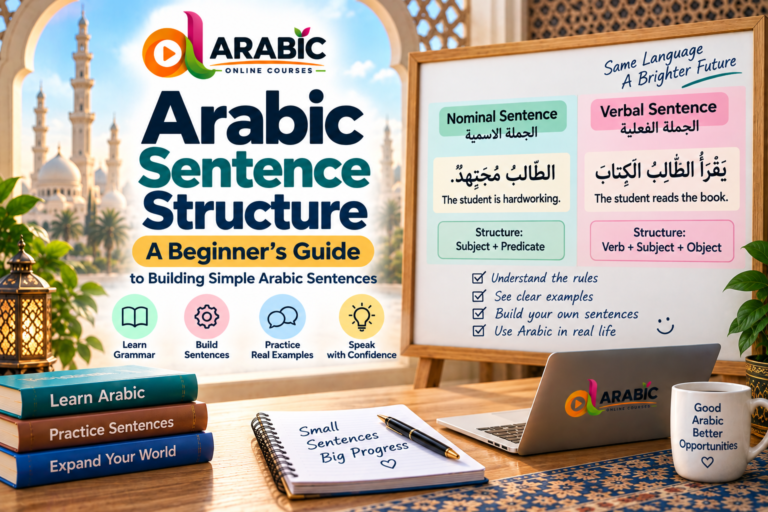
A basic Arabic sentence can follow a verbal or nominal structure.
Verbal Sentence
A verbal sentence often begins with a verb.
Example:
كَتَبَ الطَّالِبُ الدَّرْسَ.
The student wrote the lesson.
The structure is:
Verb + Subject + Object
- كَتَبَ = Wrote
- الطَّالِبُ = The student
- الدَّرْسَ = The lesson
Nominal Sentence
A nominal sentence begins with a noun or pronoun.
Example:
الطَّالِبُ يَكْتُبُ الدَّرْسَ.
The student writes the lesson.
The structure is:
Subject + Verb + Object
Understanding basic Arabic sentence structure will help you use verbs more naturally.
Useful Arabic Verb Expressions
أُرِيدُ أَنْ… | I want to… |
أَسْتَطِيعُ أَنْ… | I can… |
لَا أَسْتَطِيعُ أَنْ… | I cannot… |
أُحِبُّ أَنْ… | I like to… |
أَحْتَاجُ إِلَى… | I need… |
أَذْهَبُ إِلَى… | I go to… |
أَتَعَلَّمُ… | I learn… |
أَفْهَمُ… | I understand… |
لَا أَفْهَمُ… | I do not understand… |
أَتَكَلَّمُ… | I speak… |
Examples:
- أُرِيدُ أَنْ أَتَعَلَّمَ الْعَرَبِيَّةَ.
I want to learn Arabic. - لَا أَفْهَمُ السُّؤَالَ.
I do not understand the question. - أَسْتَطِيعُ أَنْ أَتَكَلَّمَ بِالْعَرَبِيَّةِ.
I can speak Arabic.
After learning common Arabic verbs and useful expressions, the next step is to use them in real communication. Practicing Arabic Conversation for Beginners can help you turn individual verbs and phrases into short, practical conversations used in everyday situations.
Tips for Learning Arabic Verbs for Beginners
1. Learn Verbs with Examples
Do not memorize a verb alone. Learn it in a short sentence.
For example:
- يَقْرَأُ = He reads
- هُوَ يَقْرَأُ كِتَابًا = He reads a book
2. Study Verbs by Topic
Group verbs according to their use:
Education:
- دَرَسَ — To study
- تَعَلَّمَ — To learn
- عَلَّمَ — To teach
- قَرَأَ — To read
- كَتَبَ — To write
Daily Activities:
- أَكَلَ — To eat
- شَرِبَ — To drink
- نَامَ — To sleep
- ذَهَبَ — To go
- عَمِلَ — To work
3. Practice One Verb with Several Pronouns
For example:
- أَنَا أَكْتُبُ. — I write.
- أَنْتَ تَكْتُبُ. — You write.
- أَنْتِ تَكْتُبِينَ. — You write.
- هُوَ يَكْتُبُ. — He writes.
- هِيَ تَكْتُبُ. — She writes.
- نَحْنُ نَكْتُبُ. — We write.
4. Listen and Repeat
Listening to Arabic conversations helps you recognize verb forms and pronunciation. Regular practice through online Arabic lessons can help you improve your vocabulary, grammar, and speaking skills.
5. Use Verbs in Daily Conversations
Try describing your daily routine:
- أَسْتَيْقِظُ فِي الصَّبَاحِ.
I wake up in the morning. - أَشْرَبُ الْقَهْوَةَ.
I drink coffee. - أَذْهَبُ إِلَى الْعَمَلِ.
I go to work. - أَدْرُسُ الْعَرَبِيَّةَ.
I study Arabic. - أَنَامُ فِي اللَّيْلِ.
I sleep at night.
Using Arabic verbs to describe your daily routine is an effective way to make new vocabulary easier to remember. You can also explore Arabic for Daily Life to learn common words, expressions, and phrases used in everyday situations.
Regular listening can help you recognize Arabic verbs when they are used by native speakers at natural speed. Combining verb study with Arabic Listening Practice can improve your ability to recognize different verb forms, pronunciation patterns, and common expressions in context.
Frequently Asked Questions
What are Arabic verbs?
Arabic verbs are words that describe actions, events, or states. Examples include كَتَبَ (to write), قَرَأَ (to read), and دَرَسَ (to study).
What are the main Arabic verb tenses?
The main Arabic verb tenses are the past tense, present tense, and future tense. The future is commonly expressed using a present-tense verb with سَـ or سَوْفَ.
What is the easiest Arabic verb for beginners to learn?
Common verbs such as دَرَسَ (to study), كَتَبَ (to write), قَرَأَ (to read), أَكَلَ (to eat), and ذَهَبَ (to go) are useful starting points for beginners.
Do Arabic verbs change according to gender?
Yes. Arabic verbs can change according to the gender of the subject. For example:
- هُوَ يَكْتُبُ — He writes.
- هِيَ تَكْتُبُ — She writes.
- أَنْتَ تَكْتُبُ — You write, masculine.
- أَنْتِ تَكْتُبِينَ — You write, feminine.
How can I memorize Arabic verbs?
Memorize verbs in short sentences, practice them with different pronouns, group them by topic, and use them in daily conversations. Repetition and listening practice are also very effective.
What is the difference between a past and present Arabic verb?
A past-tense verb describes an action that happened before, such as كَتَبَ (he wrote). A present-tense verb describes an action happening now or regularly, such as يَكْتُبُ (he writes).
Conclusion
Learning Arabic verbs for beginners is essential for communicating in Arabic. Begin with common verbs related to daily activities, education, movement, and communication.
Focus on understanding the past, present, and future tenses. Then practice conjugating verbs with different pronouns and using them in complete sentences.
With consistent practice, you will gradually develop the ability to describe actions, express your needs, and communicate more confidently in Arabic.