 Skip to the content
Online Arabic Dialects Course
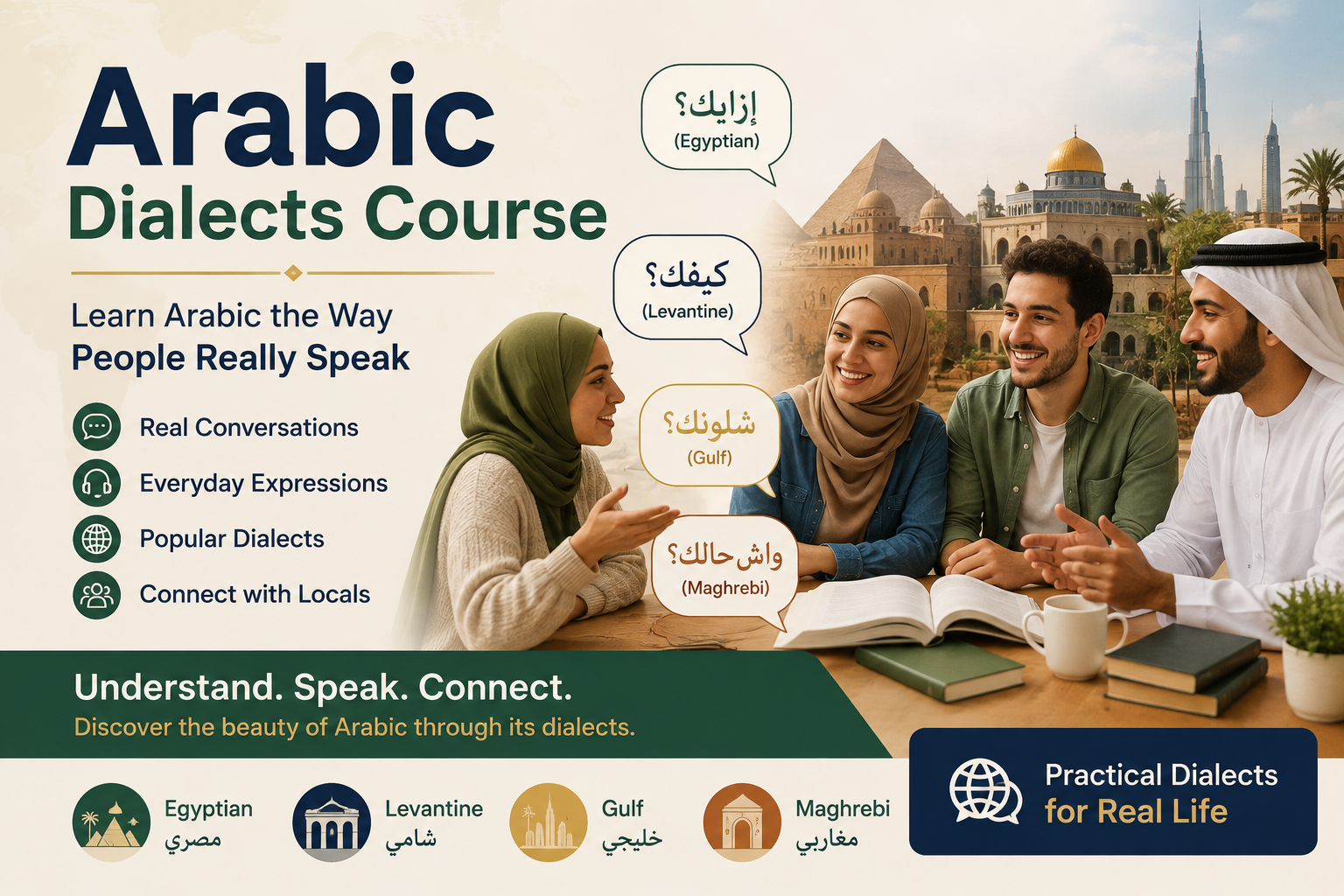
Learn Arabic the Way People Speak
Our Arabic Dialects Course helps learners move beyond formal Arabic and discover how Arabic is spoken in everyday life.
Arabic has many regional varieties, and learners often encounter different vocabulary, pronunciation, expressions, and sentence patterns when communicating with native speakers from different countries.
This course introduces learners to practical Arabic dialects and helps them understand the differences between formal Arabic and everyday spoken Arabic.
Whether you want to communicate with friends and family, travel to an Arabic-speaking country, understand local conversations, or become more comfortable speaking with native speakers, learning an Arabic dialect can make your communication more natural and practical.
What Are Arabic Dialects?
Arabic dialects are regional varieties of Arabic used in everyday communication.
While Modern Standard Arabic (MSA) is widely used in formal situations, education, news, books, and official communication, people commonly use regional dialects when speaking with family, friends, colleagues, and members of their communities.
Arabic dialects can differ in:
- Vocabulary
- Pronunciation
- Expressions
- Verb forms
- Sentence patterns
- Common greetings
- Everyday phrases
- Cultural expressions
Learning these differences can help you better understand authentic spoken Arabic.
For learners who want to build a strong foundation in formal Arabic first, explore our Modern Standard Arabic Course.
Why Learn an Arabic Dialect?
Learning a dialect can help you communicate more naturally in real-life situations.
You can learn how to:
- Understand everyday conversations.
- Speak with native Arabic speakers.
- Use common local expressions.
- Understand informal language.
- Communicate while traveling.
- Build relationships with Arabic-speaking people.
- Understand Arabic movies and social media content.
- Participate more confidently in everyday conversations.
A dialect can be especially useful when your goal is spoken communication rather than formal Arabic.
Popular Arabic Dialects
Arabic is spoken across a large geographic area, and different regions have their own varieties.
Our course can introduce learners to some of the most widely encountered Arabic dialect groups.
Egyptian Arabic
Egyptian Arabic is widely recognized through Egyptian cinema, television, music, and popular culture.
Learners can develop practical skills for situations such as:
- Greetings
- Introductions
- Shopping
- Ordering food
- Transportation
- Social conversations
- Daily activities
Levantine Arabic
Levantine Arabic refers to varieties spoken in countries such as Lebanon, Syria, Jordan, and Palestine.
Learners can develop useful language for:
- Everyday conversations
- Meeting people
- Family and social situations
- Shopping
- Restaurants
- Travel
- Informal communication
Gulf Arabic
Gulf Arabic includes varieties spoken in countries across the Arabian Gulf.
Learning Gulf Arabic can be especially useful for learners who live, work, study, or travel in the Gulf region.
The course can introduce practical expressions related to:
- Greetings
- Hospitality
- Daily life
- Shopping
- Work
- Social communication
- Travel
Other Arabic Dialects
Arabic is also spoken in North Africa and other regions, where learners may encounter different varieties and expressions.
These include dialects associated with:
- Morocco
- Algeria
- Tunisia
- Libya
- Sudan
- Yemen
- Iraq
Each variety has its own linguistic and cultural characteristics.
The goal of studying Arabic dialects is not to memorize every regional difference, but to become familiar with the variety most relevant to your communication goals.
Arabic Dialects vs. Modern Standard Arabic
One of the most common questions among Arabic learners is whether they should study MSA or a dialect.
The answer depends on your goals.
Modern Standard Arabic
MSA is useful for:
- Formal communication
- Reading
- Writing
- News
- Education
- Books
- Academic contexts
- Official communication
Arabic Dialects
Dialects are especially useful for:
- Everyday conversations
- Informal communication
- Speaking with native speakers
- Social situations
- Travel
- Local communities
- Understanding natural spoken Arabic
For a complete Arabic learning journey, many learners benefit from studying both.
You can begin with our Modern Standard Arabic Course and then develop practical spoken Arabic through our Arabic Dialects Course.
Arabic Dialects and Arabic Conversation
Learning a dialect is closely connected to developing conversation skills.
Instead of focusing only on grammar rules, dialect learning introduces the expressions people actually use in everyday communication.
You can practice:
- Greetings
- Questions and answers
- Informal expressions
- Social conversations
- Asking for information
- Shopping
- Food and restaurants
- Transportation
- Family conversations
- Everyday situations
If your main goal is general speaking and listening practice, you can also explore our Arabic Conversation Course.
What Will You Learn in Our Arabic Dialects Course?
The course focuses on practical spoken Arabic and introduces learners to the language they are likely to encounter in everyday situations.
You will learn:
Everyday Expressions
Understand and use common expressions that appear in daily conversations.
Greetings and Introductions
Learn natural ways to greet people, introduce yourself, and start conversations.
Questions and Answers
Practice common questions and natural responses.
Everyday Vocabulary
Build vocabulary related to family, food, transportation, shopping, work, and daily life.
Pronunciation
Become familiar with pronunciation differences between formal Arabic and regional varieties.
Listening
Practice understanding natural spoken Arabic and common expressions.
Speaking
Use dialect vocabulary and expressions in practical conversations.
Cultural Expressions
Learn expressions that are connected to everyday Arabic-speaking culture and social interaction.
Arabic Dialects Course Curriculum
Module 1 – Introduction to Arabic Dialects
Understand the differences between MSA and spoken Arabic.
You will learn:
- What Arabic dialects are
- Why dialects differ
- MSA vs. dialects
- Regional variation
- Choosing the right dialect for your goals
Module 2 – Greetings and Introductions
Learn natural greetings and introductions used in everyday communication.
You will practice:
- Saying hello
- Asking how someone is
- Introducing yourself
- Asking someone’s name
- Saying where you are from
- Ending a conversation
Module 3 – Everyday Expressions
Learn expressions that are commonly used in informal conversations.
Topics include:
- Thanking
- Apologizing
- Agreeing
- Disagreeing
- Asking for help
- Responding naturally
- Expressing surprise
- Showing appreciation
Module 4 – Family and Social Life
Talk about family, friends, relationships, and everyday social activities.
You will learn vocabulary and expressions for:
- Family members
- Friends
- Invitations
- Visiting people
- Social occasions
- Everyday relationships
Module 5 – Food and Restaurants
Practice useful language for restaurants, cafés, and food-related situations.
You will learn how to:
- Order food
- Ask about prices
- Ask about ingredients
- Express preferences
- Request something
- Pay the bill
Module 6 – Shopping and Everyday Services
Develop practical language for shopping and common services.
You will practice:
- Asking about prices
- Buying products
- Asking for sizes
- Comparing items
- Making requests
- Understanding common responses
Module 7 – Travel and Transportation
Learn useful dialect expressions for traveling.
Topics include:
- Asking for directions
- Transportation
- Taxis
- Airports
- Hotels
- Finding places
- Asking for information
Module 8 – Work and Daily Life
Learn language for everyday professional and social situations.
You will practice:
- Talking about your work
- Discussing schedules
- Making plans
- Asking questions
- Communicating with colleagues
Module 9 – Social Conversations
Develop your ability to participate in longer informal conversations.
You will practice:
- Talking about interests
- Discussing daily activities
- Making plans
- Talking about experiences
- Expressing opinions
- Responding naturally
Module 10 – Real-Life Arabic
Bring everything together through realistic conversations.
You will practice situations such as:
- Meeting someone new
- Visiting a friend
- Going shopping
- Eating at a restaurant
- Traveling
- Talking with colleagues
- Social gatherings
- Everyday conversations
Learn Arabic Dialects Through Real Conversations
The best way to become comfortable with a dialect is to hear and use it in context.
Instead of learning isolated words, you will encounter vocabulary and expressions through practical situations.
This approach helps you understand:
- How expressions are used.
- When certain words are appropriate.
- How native speakers communicate informally.
- How pronunciation changes in everyday speech.
- How conversations naturally develop.
Which Arabic Dialect Should You Learn?
The best dialect for you depends on where you live, who you communicate with, and why you are learning Arabic.
For example:
If you communicate mainly with Egyptians: Egyptian Arabic may be the most useful choice.
If you live or communicate in the Levant: Levantine Arabic may be more appropriate.
If you live or work in the Gulf: a Gulf Arabic variety may be more relevant.
If your goal is broad formal Arabic: start with our Modern Standard Arabic Course.
Choosing a dialect based on your real communication needs can make your learning more practical and motivating.
Arabic Dialects for Beginners
You do not need to be an advanced Arabic learner to start studying a dialect.
Beginners can learn useful expressions gradually while developing their listening and speaking skills.
However, if you are completely new to Arabic, building a basic foundation first can make dialect learning easier.
You can start with our Arabic for Beginners course and then move into dialect-specific speaking practice.
Arabic Dialects and Grammar
Arabic dialects have their own grammatical patterns and ways of forming everyday sentences.
While some structures are related to Modern Standard Arabic, spoken varieties may use different:
- Verb forms
- Pronouns
- Sentence patterns
- Negation
- Vocabulary
- Expressions
If you want to study Arabic grammar systematically, explore our Arabic Grammar Course.
Who Is This Arabic Dialects Course For?
This course is suitable for:
- Arabic learners who want to speak more naturally.
- Beginners interested in spoken Arabic.
- Intermediate Arabic learners.
- Students living in Arabic-speaking countries.
- People working with Arabic-speaking communities.
- Travelers.
- People with Arabic-speaking friends or family.
- Learners who already know MSA and want more practical speaking skills.
- Anyone interested in understanding regional Arabic varieties.
Why Choose Our Arabic Dialects Course?
Practical Language
Focus on expressions and vocabulary used in everyday communication.
Real-Life Situations
Learn through situations you are likely to encounter outside the classroom.
Speaking and Listening
Develop your ability to understand and use spoken Arabic.
Regional Awareness
Understand how Arabic changes across different regions.
Flexible Learning
Build your dialect skills according to your personal communication goals.
Progressive Practice
Move from basic expressions to longer and more natural conversations.
Combine Our Arabic Courses
Arabic courses can complement each other depending on your goals.
Arabic Dialects Course
Develop practical spoken Arabic and learn regional expressions for everyday communication.
Modern Standard Arabic Course
Build a strong foundation in formal Arabic, reading, writing, grammar, and vocabulary.
Arabic Conversation Course
Improve speaking and listening through practical conversations.
Arabic Grammar Course
Develop a deeper understanding of Arabic sentence structure and grammatical patterns.
Arabic for Beginners Course
Start learning Arabic from the alphabet and basic language skills.
By combining these courses, you can develop both formal Arabic knowledge and practical spoken communication skills.
Frequently Asked Questions
What are Arabic dialects?
Arabic dialects are regional varieties of Arabic commonly used in everyday spoken communication.
What is the difference between MSA and Arabic dialects?
Modern Standard Arabic is mainly used in formal and written contexts, while regional dialects are commonly used in everyday spoken communication.
Which Arabic dialect is the easiest to learn?
There is no single easiest Arabic dialect for everyone. The best choice depends on your goals, the people you want to communicate with, and the region you are interested in. Choosing a dialect that matches your real communication needs can make learning more practical and motivating.
Should I learn MSA or an Arabic dialect?
It depends on your goals. MSA is valuable for formal Arabic, reading, and writing, while a dialect is particularly useful for everyday spoken communication.
Can beginners learn an Arabic dialect?
Yes. Beginners can learn common expressions and practical vocabulary gradually. However, starting with basic Arabic foundations can make dialect learning easier.
Can I learn Egyptian Arabic?
Yes. Egyptian Arabic is one of the major varieties learners may choose when their communication goals involve Egypt.
Can I learn Levantine Arabic?
Yes. Levantine Arabic covers several closely related varieties used in the Levant region.
Can I learn Gulf Arabic?
Yes. Gulf Arabic varieties are useful for learners who live, work, or communicate in the Gulf region.
Do I need to learn MSA before a dialect?
No. You do not necessarily need to master MSA first. However, learning some basic Arabic structure can provide a useful foundation.
Can Arabic dialects help me speak Arabic more naturally?
Yes. Studying everyday vocabulary, expressions, pronunciation, and conversation patterns can help learners become more comfortable with spoken Arabic.
Start Learning Arabic Dialects Today
Start building your spoken Arabic skills and discover how Arabic is used in real-life conversations.