Skip to the content


Arabic Vocabulary for Beginners: 100 Essential Words and Phrases
Building a strong vocabulary is one of the most important steps in learning a new language. For anyone studying Arabic vocabulary for beginners, learning common words and useful expressions can make everyday communication easier and more enjoyable. You do not need to memorize thousands of words at once. Starting with practical vocabulary and reviewing it regularly can help you make steady progress.
Arabic is spoken in many countries and is used in different situations, including daily conversations, education, travel, business, and religious studies. By learning common Arabic words related to family, food, numbers, time, places, and everyday activities, you can begin understanding simple conversations and forming useful sentences.
In this guide, you will discover essential Arabic vocabulary for beginners, along with English meanings, pronunciation support, and practical methods for remembering new words.
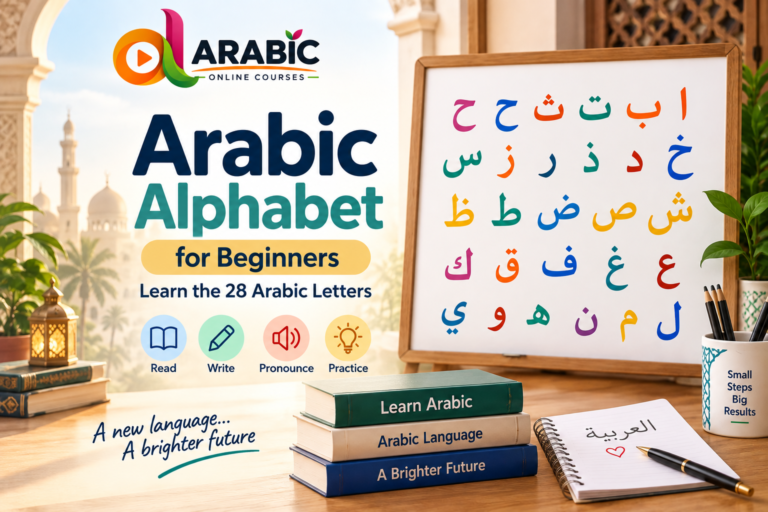
If you are new to the language, you can also read our complete guide to learning Arabic online and our guide to the Arabic alphabet for beginners.
In this guide
- Why Arabic Vocabulary Is Important
- Arabic Greetings and Common Expressions
- Arabic Vocabulary for Introducing Yourself
- Arabic Family Vocabulary
- Arabic Numbers from One to Ten
- Arabic Days of the Week
- Useful Time Expressions
- Arabic Food and Drink Vocabulary
- Arabic Colors
- Arabic Vocabulary for the Home
- Arabic School and Work Vocabulary
- Arabic Vocabulary for Daily Activities
- Arabic Places and Travel Vocabulary
- Arabic Question Words
- How to Memorize Arabic Vocabulary Effectively
- 1A Simple Arabic Vocabulary Study Plan
- Common Mistakes When Learning Arabic Vocabulary
- Learn Arabic Vocabulary with a Teacher
- Learn Arabic Pronunciation Step by Step
- Frequently Asked Questions
- Conclusion
Why Arabic Vocabulary Is Important
Vocabulary is the foundation of communication. Grammar helps you form correct sentences, but vocabulary gives you the words you need to express your thoughts.
Learning Arabic vocabulary for beginners can help you:
- Introduce yourself.
- Talk about your family.
- Order food and drinks.
- Ask for directions.
- Describe your daily routine.
- Understand simple conversations.
- Read basic Arabic texts.
- Communicate while traveling.
- Build confidence when speaking Arabic.
The best way to learn vocabulary is to study words in meaningful groups rather than memorizing unrelated lists.
Arabic Greetings and Common Expressions
Greetings are among the first words every Arabic learner should study. They are useful in almost every conversation.
English | Arabic | Pronunciation |
Hello | مرحبًا | Marhaban |
Peace be upon you | السلام عليكم | As-salaamu alaykum |
And peace be upon you | وعليكم السلام | Wa alaykum as-salaam |
Good morning | صباح الخير | Sabah al-khayr |
Good evening | مساء الخير | Masaa al-khayr |
Welcome | أهلًا وسهلًا | Ahlan wa sahlan |
Goodbye | مع السلامة | Ma‘a as-salaamah |
Thank you | شكرًا | Shukran |
You are welcome | عفوًا | Afwan |
Please | من فضلك | Min fadlik |
Yes | نعم | Na‘am |
No | لا | Laa |
Excuse me | عذرًا | ‘Uthran |
Sorry | آسف | Aasif |
Congratulations | مبروك | Mabrook |
Practice these expressions aloud and use them whenever you have the opportunity. Learning greetings is an easy way to begin using Arabic in real situations.
Greetings are an important first step in learning practical Arabic because they are used in many everyday interactions. For more examples and explanations of common expressions, explore our guide to Common Arabic Greetings.
Arabic Vocabulary for Introducing Yourself
After learning greetings, you can study words and phrases that help you introduce yourself and ask basic questions.
English | Arabic | Pronunciation |
What is your name? | ما اسمك؟ | Maa ismuk? |
My name is… | اسمي… | Ismii… |
How are you? | كيف حالك؟ | Kayfa haaluk? |
I am fine | أنا بخير | Anaa bikhayr |
Where are you from? | من أين أنت؟ | Min ayna anta? |
I am from… | أنا من… | Anaa min… |
Country | بلد | Balad |
City | مدينة | Madeenah |
Language | لغة | Lughah |
Arabic | العربية | Al-‘arabiyyah |
English | الإنجليزية | Al-injليziyyah |
Student | طالب / طالبة | Taalib / Taalibah |
Teacher | معلّم / معلّمة | Mu‘allim / Mu‘allimah |
Friend | صديق / صديقة | Sadeeq / Sadeeqah |
These words are useful when meeting new people, attending a class, or participating in a simple conversation.
Learning words for names, countries, languages, occupations, and personal information gives beginners the vocabulary they need to introduce themselves. You can practice these expressions further with our guide on Introduce Yourself in Arabic.
Arabic Family Vocabulary
Family-related words are useful because people often talk about their relatives and home life. Learning these words is an important part of Arabic vocabulary for beginners.
English | Arabic | Pronunciation |
Family | عائلة | ‘Aa’ilah |
Father | أب | Ab |
Mother | أم | Umm |
Parent | والد | Waalid |
Son | ابن | Ibn |
Daughter | ابنة | Ibnah |
Brother | أخ | Akh |
Sister | أخت | Ukht |
Husband | زوج | Zawj |
Wife | زوجة | Zawjah |
Grandfather | جد | Jadd |
Grandmother | جدة | Jaddah |
Uncle | عم / خال | ‘Amm / Khaal |
Aunt | عمة / خالة | ‘Ammah / Khaal ah |
Child | طفل / طفلة | Tifl / Tiflah |
Example Sentences About Family
- هذا أبي. — This is my father.
- هذه أمي. — This is my mother.
- عندي أخ واحد. — I have one brother.
- عائلتي كبيرة. — My family is big.
- أحب عائلتي. — I love my family.
Practice replacing the family words with information about your own family.
Arabic Numbers from One to Ten
Numbers are among the most useful words to learn in any language. They are important for shopping, telling time, discussing ages, and making appointments.
Number | Arabic | Pronunciation |
1 | واحد | Waahid |
2 | اثنان | Ithnaan |
3 | ثلاثة | Thalaathah |
4 | أربعة | Arba‘ah |
5 | خمسة | Khamsah |
6 | ستة | Sittah |
7 | سبعة | Sab‘ah |
8 | ثمانية | Thamaaniyah |
9 | تسعة | Tis‘ah |
10 | عشرة | ‘Asharah |
After learning numbers from one to ten, gradually continue with numbers up to twenty, one hundred, and beyond.
Numbers are useful in many everyday situations, including talking about age, prices, dates, times, quantities, and appointments. To continue practicing numbers beyond the basic list in this article, see our guide to Arabic Numbers for Beginners.
Arabic Days of the Week
Learning the days of the week can help you talk about your schedule, classes, work, and appointments.
English | Arabic | Pronunciation |
Sunday | الأحد | Al-Ahad |
Monday | الاثنين | Al-Ithnayn |
Tuesday | الثلاثاء | Ath-Thulaathaa’ |
Wednesday | الأربعاء | Al-Arbi‘aa’ |
Thursday | الخميس | Al-Khamees |
Friday | الجمعة | Al-Jumu‘ah |
Saturday | السبت | As-Sabt |
Useful Time Expressions
English | Arabic |
Today | اليوم |
Tomorrow | غدًا |
Yesterday | أمس |
Morning | صباح |
Evening | مساء |
Night | ليل |
Week | أسبوع |
Month | شهر |
Year | سنة |
Now | الآن |
Later | لاحقًا |
These words are useful when discussing daily plans and making simple arrangements
Time expressions become much more useful when they are combined with vocabulary for everyday activities, plans, and routines. Our guide to Arabic for Daily Life introduces practical Arabic expressions for common situations at home, work, shopping, transportation, and daily activities.
Arabic Food and Drink Vocabulary
Food and drink vocabulary is especially useful when traveling, shopping, or visiting an Arabic-speaking country.
English | Arabic | Pronunciation |
Food | طعام | Ta‘aam |
Drink | شراب | Sharaab |
Water | ماء | Maa’ |
Milk | حليب | Haleeb |
Tea | شاي | Shaay |
Coffee | قهوة | Qahwah |
Bread | خبز | Khubz |
Rice | أرز | Aruzz |
Meat | لحم | Lahm |
Chicken | دجاج | Dajaaj |
Fish | سمك | Samak |
Egg | بيضة | Baydah |
Fruit | فاكهة | Faakihah |
Vegetable | خضار | Khudaar |
Apple | تفاحة | Tuffaahah |
Banana | موز | Mawz |
Sugar | سكر | Sukkar |
Salt | ملح | Milh |
Useful Food Phrases
- أريد ماءً. — I want water.
- أحب القهوة. — I like coffee.
- هل هذا حلال؟ — Is this halal?
- أين المطعم؟ — Where is the restaurant?
- الحساب من فضلك. — The bill, please.
These expressions allow beginners to use their vocabulary in practical situations.
Food vocabulary is especially useful when ordering meals and drinks or communicating in restaurants. To learn practical expressions for ordering food, asking for the bill, and communicating with restaurant staff, explore Arabic at the Restaurant.
Arabic Colors
Colors are easy to learn and can be used to describe clothes, objects, animals, and places.
English | Arabic | Pronunciation |
Red | أحمر | Ahmar |
Blue | أزرق | Azraq |
Green | أخضر | Akhdar |
Yellow | أصفر | Asfar |
Black | أسود | Aswad |
White | أبيض | Abyad |
Brown | بني | Bunni |
Orange | برتقالي | Bortoqaal i |
Pink | وردي | Wardi |
Purple | بنفسجي | Banafsaji |
Gray | رمادي | Ramaadi |
Remember that some Arabic color words change according to the gender of the noun they describe. Beginners can first learn the basic forms and study these grammatical changes later.
Arabic Vocabulary for the Home
Home-related words are useful for describing where you live and identifying objects around you.
English | Arabic | Pronunciation |
House | بيت | Bayt |
Room | غرفة | Ghurfah |
Door | باب | Baab |
Window | نافذة | Naafidhah |
Kitchen | مطبخ | Matbakh |
Bathroom | حمّام | Hammaam |
Bedroom | غرفة النوم | Ghurfat an-nawm |
Living room | غرفة الجلوس | Ghurfat al-juloos |
Chair | كرسي | Kursi |
Table | طاولة | Taawilah |
Bed | سرير | Sareer |
Book | كتاب | Kitaab |
Pen | قلم | Qalam |
Key | مفتاح | Miftaah |
Wall | جدار | Jidaar |
Example Sentences About the Home
- هذا بيتي. — This is my house.
- هذه غرفتي. — This is my room.
- الكتاب على الطاولة. — The book is on the table.
- الباب مفتوح. — The door is open.
- المطبخ صغير. — The kitchen is small.
Arabic School and Work Vocabulary
Students and professionals can benefit from learning vocabulary related to education and work.
English | Arabic | Pronunciation |
School | مدرسة | Madrasah |
University | جامعة | Jaami‘ah |
Class | فصل / صف | Fasl / Saff |
Lesson | درس | Dars |
Book | كتاب | Kitaab |
Notebook | دفتر | Daftar |
Pen | قلم | Qalam |
Question | سؤال | Su’aal |
Answer | جواب | Jawaab |
Exam | امتحان | Imtihaan |
Homework | واجب منزلي | Waajib manzili |
Office | مكتب | Maktab |
Company | شركة | Sharikah |
Job | وظيفة | Wazيفah |
Work | عمل | ‘Amal |
Meeting | اجتماع | Ijtimaa‘ |
Useful Educational Phrases
- أين الدرس؟ — Where is the lesson?
- عندي سؤال. — I have a question.
- لا أفهم. — I do not understand.
- هل يمكنك التكرار؟ — Can you repeat?
- أحتاج إلى المساعدة. — I need help.
Learners who use Arabic in a professional environment need vocabulary that goes beyond general everyday words. Our Arabic for Work guide focuses on useful Arabic for workplace situations, professional communication, and common work-related interactions.
Arabic Vocabulary for Daily Activities
Learning verbs and daily activity words can help you describe your routine.
English | Arabic | Pronunciation |
Wake up | يستيقظ | Yastayqiz |
Sleep | ينام | Yanaam |
Eat | يأكل | Ya’kul |
Drink | يشرب | Yashrab |
Go | يذهب | Yadhhab |
Come | يأتي | Ya’ti |
Read | يقرأ | Yaqra’ |
Write | يكتب | Yaktub |
Study | يدرس | Yadrus |
Work | يعمل | Ya‘mal |
Play | يلعب | Yal‘ab |
Speak | يتكلم | Yatakallam |
Listen | يستمع | Yastami‘ |
Watch | يشاهد | Yushaahid |
Open | يفتح | Yaftah |
Close | يغلق | Yughliq |
Example Sentences About Daily Activities
- أستيقظ صباحًا. — I wake up in the morning.
- أذهب إلى العمل. — I go to work.
- أدرس العربية. — I study Arabic.
- أقرأ كتابًا. — I read a book.
- أشرب الشاي. — I drink tea.
- أنام في الليل. — I sleep at night.
These examples combine vocabulary with basic Arabic grammar, including verbs, nouns, pronouns, and sentence patterns. If you want to understand how these elements work together, our guide to Arabic Grammar for Beginners provides a step-by-step introduction to essential Arabic grammar.
Arabic Places and Travel Vocabulary
Travel vocabulary is useful for learners who plan to visit Arabic-speaking countries or communicate with people from different regions.
English | Arabic | Pronunciation |
Airport | مطار | Mataar |
Hotel | فندق | Funduq |
Restaurant | مطعم | Mat‘am |
Market | سوق | Sooq |
Store | متجر | Matjar |
Street | شارع | Shaari‘ |
City | مدينة | Madeenah |
Country | بلد | Balad |
Hospital | مستشفى | Mustashfaa |
Pharmacy | صيدلية | Saydaliyyah |
Bank | بنك | Bank |
Station | محطة | Mahattah |
Bus | حافلة | Haafilah |
Car | سيارة | Sayyaarah |
Train | قطار | Qitaar |
Taxi | سيارة أجرة | Sayyaarat ujrah |
Useful Travel Phrases
- أين المطار؟ — Where is the airport?
- أين الفندق؟ — Where is the hotel?
- كم السعر؟ — How much is the price?
- أريد سيارة أجرة. — I want a taxi.
- أين أقرب مستشفى؟ — Where is the nearest hospital?
- هل تتحدث الإنجليزية؟ — Do you speak English?
- لا أفهم العربية جيدًا. — I do not understand Arabic well.
Travelers can benefit from learning vocabulary for airports, hotels, restaurants, transportation, directions, and shopping before visiting an Arabic-speaking country. Our Arabic for Travel guide brings these practical situations together with useful expressions for travelers.
Arabic Question Words
Question words are essential because they help you create conversations and ask for information.
English | Arabic | Pronunciation |
What? | ماذا / ما | Maadhaa / Maa |
Who? | من | Man |
Where? | أين | Ayna |
When? | متى | Mataa |
Why? | لماذا | Limaadhaa |
How? | كيف | Kayfa |
How much? | كم | Kam |
Which? | أيّ | Ayy |
Is? / Are? | هل | Hal |
Example Questions
- ما هذا؟ — What is this?
- من هذا؟ — Who is this?
- أين الكتاب؟ — Where is the book?
- متى الدرس؟ — When is the lesson?
- كيف حالك؟ — How are you?
- كم السعر؟ — How much is the price?
Question words are essential for turning vocabulary into real communication because they allow learners to ask for information and keep a conversation going. You can practice common questions and everyday expressions in our guide to Arabic Questions for Beginners.
How to Memorize Arabic Vocabulary Effectively
Learning Arabic vocabulary for beginners becomes easier when you use an organized study method. Memorizing a long list once is not enough. You need to review and use new words regularly.
- Learn Words by Topic
Study vocabulary in groups such as:
- Family
- Food
- School
- Travel
- Home
- Colors
- Numbers
- Daily activities
Words connected by a topic are easier to remember.
- Use Flashcards
Create flashcards with the Arabic word on one side and the English meaning on the other. You can also include an image or an example sentence.
- Write Example Sentences
Do not memorize a word alone. Use it in a simple sentence.
For example:
- كتاب — Book
- هذا كتاب. — This is a book.
This helps you understand how the word is used naturally.
- Practice Pronunciation
Say each word aloud several times. Listening and speaking are important parts of learning new vocabulary.
For additional support with difficult Arabic sounds, read our guide to Arabic pronunciation for beginners.
- Review Regularly
Review new words after:
- One day.
- Three days.
- One week.
- Two weeks.
- One month.
Regular review helps move vocabulary from short-term memory into long-term memory.
- Use New Words in Conversations
Try to use newly learned words with a teacher, friend, or language partner. Even short sentences can help you remember vocabulary more effectively.
1A Simple Arabic Vocabulary Study Plan
You can follow this 30-minute daily routine:
Time | Activity |
5 minutes | Review previously learned words |
10 minutes | Learn 5–10 new words |
5 minutes | Listen to the pronunciation |
5 minutes | Write example sentences |
5 minutes | Practice speaking aloud |
Avoid learning too many words in one day. Learning five to ten words and using them correctly is often more effective than memorizing a large list without practice.
Common Mistakes When Learning Arabic Vocabulary
Memorizing Words Without Context
A word may have different meanings depending on the sentence. Always try to learn vocabulary in context.
Depending Only on English Transliteration
Transliteration can help with pronunciation at the beginning, but learning the Arabic script is essential for long-term progress.
Ignoring Gender
Arabic nouns may be masculine or feminine, and this can affect adjectives and verbs. Learn the gender of common nouns gradually.
Not Reviewing Old Words
Learning new vocabulary while forgetting previously learned words can slow your progress. Review old words regularly.
Learning Without Speaking
Vocabulary becomes more useful when you use it in real conversations. Practice speaking from the beginning, even with simple phrases.
Learn Arabic Vocabulary with a Teacher
Self-study resources can help you learn new words, but a qualified teacher can show you how to pronounce them, use them in sentences, and understand their meanings in context.
Structured online Arabic lessons can help beginners develop vocabulary alongside reading, writing, listening, and speaking skills. A teacher can also create lessons based on your goals, whether you want to learn Arabic for travel, education, work, or religious studies.
If you are ready to begin learning with guidance, you can book a trial lesson and explore a suitable Arabic learning program.
Learn Arabic Pronunciation Step by Step
Arabic pronunciation becomes easier when learners follow a gradual learning process.
Start by learning the Arabic alphabet and the basic sounds of each letter. Then practice short vowels, long vowels, and difficult sounds. After that, begin reading simple words and sentences aloud.
If you are continuing from the alphabet stage, our guide to learning Arabic from scratch can help you organize the next steps of your language-learning journey.
Learners who want personalized guidance can also book a trial lesson to practice pronunciation and receive feedback from an experienced teacher.
Frequently Asked Questions
How many Arabic words should beginners learn?
The time varies depending on your practice routine, language background, and the sounds you need to learn. Regular practice for a few minutes each day can lead to noticeable improvement over time.
What Arabic vocabulary should I learn first?
Start with greetings, introductions, family words, numbers, food, daily activities, and common question words. These topics are useful in everyday communication.
How can I memorize Arabic vocabulary faster?
Learn words by topic, use flashcards, write example sentences, practice pronunciation, and review vocabulary regularly.
Should I learn Arabic words with or without vowel marks?
Beginners can benefit from learning words with vowel marks because they make pronunciation easier. As your reading skills improve, you can gradually become familiar with texts without vowel marks.
Is Arabic vocabulary different between countries?
Some words and expressions vary between Arabic dialects. Modern Standard Arabic is widely used in formal writing, education, and official communication, while dialects are common in everyday speech.
How long does it take to build basic Arabic vocabulary?
The time depends on your study routine and practice. With consistent daily study, learners can build a useful foundation of vocabulary over several weeks and continue expanding it over time.
Conclusion
Learning Arabic vocabulary for beginners is an important step toward understanding and speaking Arabic. By studying common words related to greetings, family, food, numbers, time, travel, school, and daily activities, you can begin communicating in practical situations.
Remember that vocabulary learning requires regular review and active use. Study a small number of words each day, practice their pronunciation, and use them in simple sentences and conversations.
With patience and consistency, your Arabic vocabulary will continue to grow, helping you communicate with greater confidence and understanding.
Start learning useful Arabic words today and take another step toward speaking Arabic confidently.