Skip to the content


Arabic Pronouns: A Beginner’s Guide to Personal Pronouns
Learning Arabic becomes much easier when you understand how pronouns work. Pronouns are essential words that replace nouns and help us speak and write without repeating the same names or objects.
For example, instead of saying:
Ahmed is a student. Ahmed studies Arabic.
We can say:
Ahmed is a student. He studies Arabic.
In Arabic, pronouns are also used to indicate who is speaking, who is being addressed, or who is being discussed.
This guide introduces the most important Arabic pronouns for beginners, with clear explanations, English meanings, and simple examples.
Arabic pronouns are an important part of the wider Arabic grammar system because they connect with verbs, nouns, adjectives, and sentence structure. If you are building your grammar foundation, our guide to Arabic Grammar for Beginners introduces these essential concepts step by step.
In this guide
- What Are Arabic Pronouns?
- Arabic Personal Pronouns
- Arabic Personal Pronouns Chart
- Masculine and Feminine in Arabic
- Arabic Pronouns and Verb Agreement
- Attached Arabic Pronouns
- Attached Arabic Pronouns
- Demonstrative Pronouns in Arabic
- Common Mistakes with Arabic Pronouns
- How to Practice Arabic Pronouns
- Final Thoughts
- Frequently Asked Questions
- Conclusion
What Are Arabic Pronouns?
Arabic pronouns are words used instead of nouns or names. They can refer to:
- The person speaking
- The person being spoken to
- Another person or group
- Objects or things in certain grammatical situations
Arabic pronouns can be divided into several categories, including:
- Independent personal pronouns
- Attached pronouns
- Demonstrative pronouns
- Relative pronouns
- Interrogative pronouns
For beginners, it is best to start with independent personal pronouns because they are commonly used in simple sentences.
If you are completely new to Arabic, it is useful to learn pronouns alongside basic vocabulary, pronunciation, sentence patterns, and everyday expressions. Our Arabic for Beginners course provides a structured introduction to these essential language skills.
Arabic Personal Pronouns
Personal pronouns identify the speaker, listener, or person being discussed. Arabic personal pronouns are different depending on:
- Person: first, second, or third
- Number: singular, dual, or plural
- Gender: masculine or feminine
English mainly distinguishes between singular and plural. Arabic also has a special form for two people or two things called the dual.
Arabic Personal Pronouns Chart
Arabic Pronoun | Transliteration | English Meaning |
أَنَا | Anā | I |
نَحْنُ | Naḥnu | We |
أَنْتَ | Anta | You — masculine singular |
أَنْتِ | Anti | You — feminine singular |
أَنْتُمَا | Antumā | You two |
أَنْتُمْ | Antum | You — masculine plural |
أَنْتُنَّ | Antunna | You — feminine plural |
هُوَ | Huwa | He |
هِيَ | Hiya | She |
هُمَا | Humā | They two |
هُمْ | Hum | They — masculine plural |
هُنَّ | Hunna | They — feminine plural |
Let us examine these pronouns in more detail.
First-Person Arabic Pronouns
First-person pronouns refer to the person or people speaking.
1. أَنَا — Anā — I
The pronoun أَنَا means “I.” It is used by both males and females.
Examples:
- أَنَا طَالِبٌ.
Anā ṭālibun.
I am a male student. - أَنَا طَالِبَةٌ.
Anā ṭālibatun.
I am a female student. - أَنَا مِنْ عُمَانَ.
Anā min ʿUmān.
I am from Oman.
Notice that the pronoun أَنَا does not change according to the speaker’s gender. However, the noun or adjective following it may change.
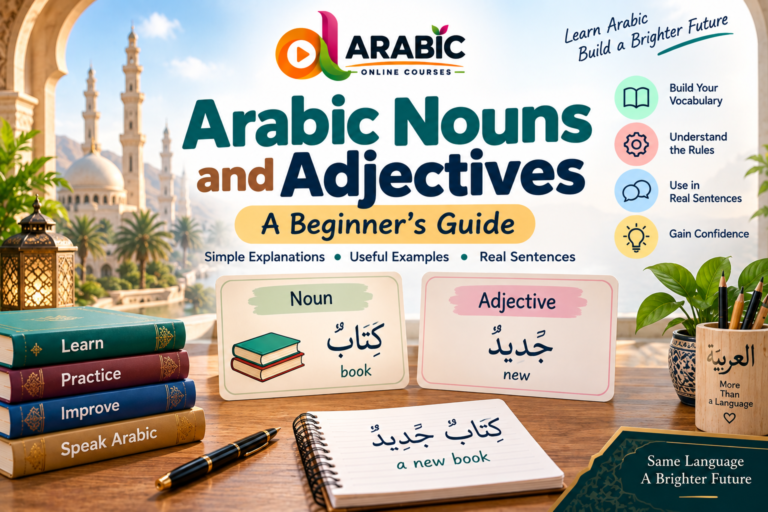
Notice how the noun or adjective can change according to gender when it follows a pronoun. Understanding this relationship is easier when you study Arabic Nouns and Adjectives, including gender and agreement between nouns and adjectives.
2. نَحْنُ — Naḥnu — We
The pronoun نَحْنُ means “we.” It is used for a group that includes the speaker.
Examples:
- نَحْنُ طُلَّابٌ.
Naḥnu ṭullābun.
We are students. - نَحْنُ نَتَعَلَّمُ الْعَرَبِيَّةَ.
Naḥnu nataʿallamu al-ʿarabiyyata.
We are learning Arabic. - نَحْنُ مِنْ أَلْمَانِيَا.
Naḥnu min Almāniyā.
We are from Germany.
Arabic uses one common first-person plural pronoun for both masculine and feminine groups.
Second-Person Arabic Pronouns
Second-person pronouns refer to the person or people being addressed. Arabic distinguishes between masculine and feminine forms.
1. أَنْتَ — Anta — You, Masculine Singular
Use أَنْتَ when speaking to one male.
Examples:
- أَنْتَ طَالِبٌ.
Anta ṭālibun.
You are a male student. - أَنْتَ مُعَلِّمٌ.
Anta muʿallimun.
You are a male teacher. - أَنْتَ مِنْ مِصْرَ.
Anta min Miṣr.
You are from Egypt.
2. أَنْتِ — Anti — You, Feminine Singular
Use أَنْتِ when speaking to one female.
Examples:
- أَنْتِ طَالِبَةٌ.
Anti ṭālibatun.
You are a female student. - أَنْتِ مُعَلِّمَةٌ.
Anti muʿallimatun.
You are a female teacher. - أَنْتِ مِنْ عُمَانَ.
Anti min ʿUmān.
You are from Oman.
The difference between أَنْتَ and أَنْتِ is important:
- أَنْتَ = You, masculine
- أَنْتِ = You, feminine
3. أَنْتُمَا — Antumā — You Two
The pronoun أَنْتُمَا is used when speaking to two people. It can refer to two males, two females, or one male and one female.
Examples:
- أَنْتُمَا طَالِبَانِ.
Antumā ṭālibāni.
You two are male students. - أَنْتُمَا طَالِبَتَانِ.
Antumā ṭālibatāni.
You two are female students. - أَنْتُمَا مُعَلِّمَانِ.
Antumā muʿallimāni.
You two are teachers.
The dual form is one of the special features of Arabic grammar.
4. أَنْتُمْ — Antum — You, Masculine Plural
Use أَنْتُمْ when speaking to a group of males or a mixed-gender group in many standard Arabic contexts.
Examples:
- أَنْتُمْ طُلَّابٌ.
Antum ṭullābun.
You are students. - أَنْتُمْ مُجْتَهِدُونَ.
Antum mujtahidūna.
You are hardworking. - أَنْتُمْ تَتَعَلَّمُونَ الْعَرَبِيَّةَ.
Antum tataʿallamūna al-ʿarabiyyata.
You are learning Arabic.
5. أَنْتُنَّ — Antunna — You, Feminine Plural
Use أَنْتُنَّ when speaking to a group of females.
Examples:
- أَنْتُنَّ طَالِبَاتٌ.
Antunna ṭālibātun.
You are female students. - أَنْتُنَّ مُجْتَهِدَاتٌ.
Antunna mujtahidātun.
You are hardworking. - أَنْتُنَّ تَدْرُسْنَ الْعَرَبِيَّةَ.
Antunna tadrusna al-ʿarabiyyata.
You are studying Arabic.
In everyday spoken Arabic, many dialects use simpler forms instead of أَنْتُنَّ, but it is useful for learners of Modern Standard Arabic.
Third-Person Arabic Pronouns
Third-person pronouns refer to someone or something being discussed.
1. هُوَ — Huwa — He
Use هُوَ to refer to one male.
Examples:
- هُوَ طَالِبٌ.
Huwa ṭālibun.
He is a student. - هُوَ مُعَلِّمٌ.
Huwa muʿallimun.
He is a teacher. - هُوَ يَقْرَأُ كِتَابًا.
Huwa yaqraʾu kitāban.
He is reading a book.
2. هِيَ — Hiya — She
Use هِيَ to refer to one female.
Examples:
- هِيَ طَالِبَةٌ.
Hiya ṭālibatun.
She is a student. - هِيَ مُعَلِّمَةٌ.
Hiya muʿallimatun.
She is a teacher. - هِيَ تَكْتُبُ رِسَالَةً.
Hiya taktubu risālatan.
She is writing a letter.
3. هُمَا — Humā — They Two
The pronoun هُمَا refers to two people or two things.
Examples:
- هُمَا طَالِبَانِ.
Humā ṭālibāni.
They two are male students. - هُمَا طَالِبَتَانِ.
Humā ṭālibatāni.
They two are female students. - هُمَا يَدْرُسَانِ الْعَرَبِيَّةَ.
Humā yadrusāni al-ʿarabiyyata.
They two are studying Arabic.
4. هُمْ — Hum — They, Masculine Plural
Use هُمْ for a group of males or a mixed-gender group in many formal contexts.
Examples:
- هُمْ طُلَّابٌ.
Hum ṭullābun.
They are students. - هُمْ مُعَلِّمُونَ.
Hum muʿallimūna.
They are teachers. - هُمْ يَتَحَدَّثُونَ بِالْعَرَبِيَّةِ.
Hum yataḥaddathūna bil-ʿarabiyyati.
They speak Arabic.
5. هُنَّ — Hunna — They, Feminine Plural
Use هُنَّ for a group of females.
Examples:
- هُنَّ طَالِبَاتٌ.
Hunna ṭālibātun.
They are female students. - هُنَّ مُعَلِّمَاتٌ.
Hunna muʿallimātun.
They are female teachers. - هُنَّ يَقْرَأْنَ الْكُتُبَ.
Hunna yaqraʾna al-kutuba.
They read books.
Masculine and Feminine in Arabic
Arabic nouns are generally classified as masculine or feminine. This distinction affects adjectives, verbs, and other words connected to the noun.
Masculine Nouns
Examples:
- ولد — Boy
- طالب — Male student
- كتاب — Book
- قلم — Pen
- باب — Door
Feminine Nouns
Examples:
- بنت — Girl
- طالبة — Female student
- سيارة — Car
- مدرسة — School
- شجرة — Tree
Many feminine nouns end with ة, called taa marbuta, although not every feminine noun follows this pattern.
Examples of Gender Agreement
- طالبٌ مجتهدٌ. — A hardworking male student.
- طالبةٌ مجتهدةٌ. — A hardworking female student.
- ولدٌ صغيرٌ. — A young boy.
- بنتٌ صغيرةٌ. — A young girl.
The adjective must agree with the noun in gender.
Arabic Pronouns and Verb Agreement
Gender is an important part of Arabic grammar. Arabic nouns, adjectives, and verbs often change according to whether they are masculine or feminine.
Compare these sentences:
- هُوَ طَالِبٌ.
He is a student. - هِيَ طَالِبَةٌ.
She is a student.
The word طَالِبٌ is masculine, while طَالِبَةٌ is feminine.
Another example:
- هُوَ مُجْتَهِدٌ.
He is hardworking. - هِيَ مُجْتَهِدَةٌ.
She is hardworking.
When learning Arabic pronouns, it is useful to memorize each pronoun together with a short example sentence.
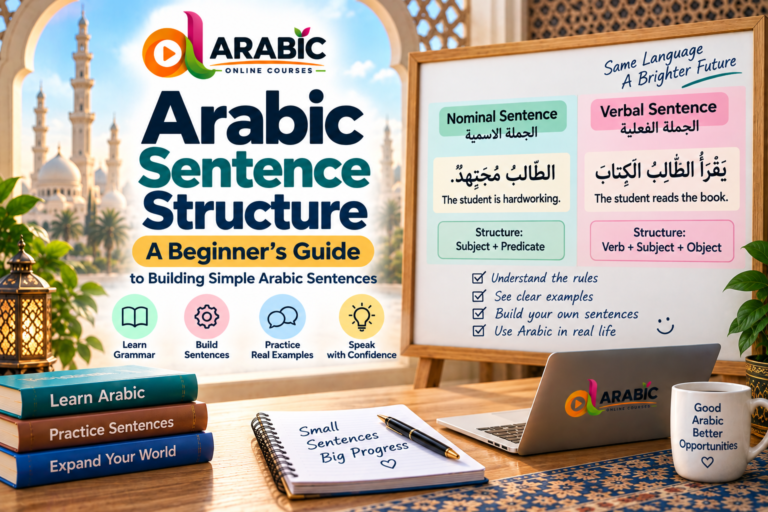
Pronouns frequently appear as subjects in simple Arabic sentences. Learning Arabic Sentence Structure can help you understand how pronouns work with predicates, verbs, objects, and other parts of a sentence.
Attached Arabic Pronouns
Arabic verbs often change depending on the pronoun. For example, the verb “to study” is دَرَسَ in the past tense, while the present-tense forms change according to the subject.
Here are some simple present-tense examples using the verb يَدْرُسُ, meaning “to study”:
Pronoun | Arabic Sentence | English Meaning |
أَنَا | أَنَا أَدْرُسُ | I study |
نَحْنُ | نَحْنُ نَدْرُسُ | We study |
أَنْتَ | أَنْتَ تَدْرُسُ | You study |
أَنْتِ | أَنْتِ تَدْرُسِينَ | You study |
هُوَ | هُوَ يَدْرُسُ | He studies |
هِيَ | هِيَ تَدْرُسُ | She studies |
هُمْ | هُمْ يَدْرُسُونَ | They study |
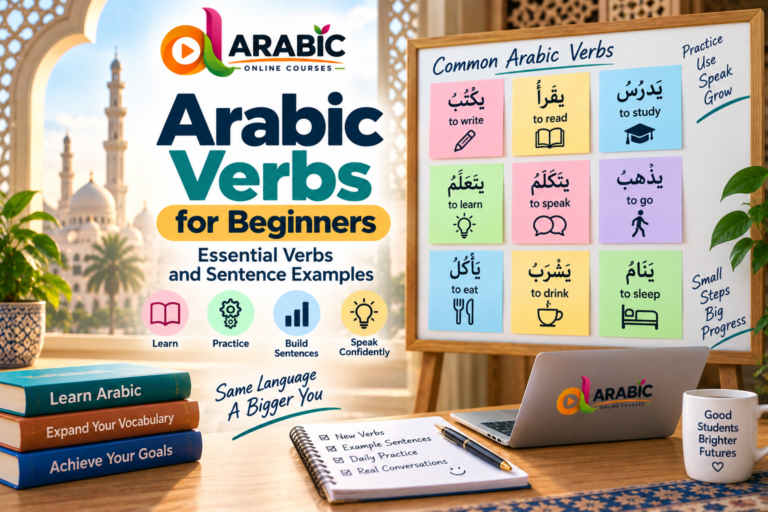
Arabic pronouns are closely connected to verb conjugation because the form of a verb changes according to the subject. To practice these patterns in more detail, explore our guide to Arabic Verbs for Beginners with common verbs, conjugation patterns, and practical examples.
Attached Arabic Pronouns
In addition to independent pronouns, Arabic also uses attached pronouns. These pronouns are connected to nouns, verbs, or prepositions.
For example:
- كِتَابِي
Kitābī
My book - كِتَابُكَ
Kitābuka
Your book — masculine - كِتَابُكِ
Kitābuki
Your book — feminine - كِتَابُهُ
Kitābuhu
His book - كِتَابُهَا
Kitābuhā
Her book
Here are some common attached pronouns:
Attached Pronoun | Meaning | Example | Translation |
ـِي | My | كِتَابِي | My book |
ـنَا | Our | كِتَابُنَا | Our book |
ـكَ | Your, masculine | كِتَابُكَ | Your book |
ـكِ | Your, feminine | كِتَابُكِ | Your book |
ـهُ | His | كِتَابُهُ | His book |
ـهَا | Her | كِتَابُهَا | Her book |
ـهُمْ | Their, masculine plural | كِتَابُهُمْ | Their book |
Attached pronouns are very common in Arabic. You will encounter them when learning vocabulary, reading texts, and practicing conversations.
Once you understand the basic Arabic pronouns, you can gradually explore more advanced grammatical relationships, including case endings, sentence patterns, verb agreement, and other grammatical structures. Our Arabic Grammar Course provides a broader and more systematic study of Arabic grammar.
Demonstrative Pronouns in Arabic
Demonstrative pronouns are used to point to people or things. They often mean “this,” “that,” “these,” or “those.”
Some common Arabic demonstrative pronouns include:
Arabic | Transliteration | Meaning |
هَذَا | Hādhā | This — masculine |
هَذِهِ | Hādhihi | This — feminine |
هَؤُلَاءِ | Hāʾulāʾi | These |
ذَلِكَ | Dhālika | That — masculine |
تِلْكَ | Tilka | That — feminine |
أُولَئِكَ | Ulāʾika | Those |
Examples:
- هَذَا كِتَابٌ.
This is a book. - هَذِهِ سَيَّارَةٌ.
This is a car. - هَؤُلَاءِ طُلَّابٌ.
These are students. - ذَلِكَ بَيْتٌ.
That is a house.
Demonstrative pronouns are useful when describing objects and introducing new vocabulary.
Common Mistakes with Arabic Pronouns
Beginners often make a few common mistakes when using Arabic pronouns.
1. Confusing أَنْتَ and أَنْتِ
Remember:
- أَنْتَ is used for one male.
- أَنْتِ is used for one female.
2. Forgetting Gender Agreement
The pronoun and the words connected to it should agree in gender.
Incorrect or mismatched usage can make the sentence sound unnatural.
Compare:
- هُوَ طَالِبٌ.
He is a student. - هِيَ طَالِبَةٌ.
She is a student.
3. Using English Word Order
Arabic sentence structure may differ from English. For example:
- هُوَ يَقْرَأُ كِتَابًا.
He is reading a book.
It is important to practice complete Arabic sentences rather than translating each word separately.
4. Ignoring the Dual Form
Arabic has special forms for two people or two things. Do not confuse:
- هُوَ = He
- هُمَا = They two
- هُمْ = They
How to Practice Arabic Pronouns
Here are some effective ways to practice Arabic pronouns:
1. Memorize the Pronouns in Groups
Start with these basic forms:
- أَنَا = I
- نَحْنُ = We
- أَنْتَ = You, masculine
- أَنْتِ = You, feminine
- هُوَ = He
- هِيَ = She
Then gradually learn the dual and plural forms.
2. Create Simple Sentences
Use each pronoun with familiar vocabulary.
For example:
- أَنَا مُعَلِّمٌ.
I am a teacher. - هُوَ طَبِيبٌ.
He is a doctor. - هِيَ طَالِبَةٌ.
She is a student. - نَحْنُ أَصْدِقَاءُ.
We are friends.
Creating sentences with pronouns becomes easier when you have a useful set of everyday words to work with. Our Arabic Vocabulary for Beginners guide introduces essential words and expressions that you can combine with pronouns to create simple sentences.
3. Practice with Verbs
Choose one verb and practice it with different pronouns.
For example:
- أَنَا أَكْتُبُ. — I write.
- أَنْتَ تَكْتُبُ. — You write.
- أَنْتِ تَكْتُبِينَ. — You write.
- هُوَ يَكْتُبُ. — He writes.
- هِيَ تَكْتُبُ. — She writes.
- نَحْنُ نَكْتُبُ. — We write.
4. Listen and Repeat
Listening to Arabic conversations can help you recognize pronouns naturally. You can practice through online Arabic lessons, educational videos, or conversations with a teacher.
5. Use Pronouns in Daily Conversations
Try introducing yourself and describing people around you:
- أَنَا سَعِيدٌ.
I am Saeed. - هُوَ صَدِيقِي.
He is my friend. - هِيَ مُعَلِّمَتِي.
She is my teacher. - نَحْنُ نَتَعَلَّمُ الْعَرَبِيَّةَ.
We are learning Arabic.
The best way to make Arabic pronouns feel natural is to use them in short conversations rather than memorizing them in isolation. Practicing Arabic Conversation for Beginners can help you use pronouns when introducing yourself, asking questions, and talking about people and everyday activities.
Final Thoughts
Understanding Arabic pronouns is an essential step toward speaking, reading, and writing Arabic correctly. Begin with the most common independent pronouns, then practice gender, number, verb agreement, and attached pronouns.
The key pronouns to learn first are:
- أَنَا — I
- نَحْنُ — We
- أَنْتَ — You, masculine
- أَنْتِ — You, feminine
- هُوَ — He
- هِيَ — She
- هُمْ — They
With regular practice, Arabic pronouns will become familiar and help you build longer and more accurate sentences.
If you want to improve your Arabic step by step, explore Arabic vocabulary for beginners and continue practicing basic sentence patterns through structured Arabic learning.
Frequently Asked Questions
Is Arabic grammar difficult for beginners?
Arabic grammar can seem difficult because it includes features such as gender, dual forms, and different verb patterns. However, learning one topic at a time makes the process more manageable.
What should I learn first in Arabic grammar?
Start with nouns, pronouns, masculine and feminine forms, basic verbs, prepositions, and simple sentence structure.
Does Arabic have grammar rules similar to English?
Some concepts are similar, such as nouns, verbs, adjectives, and pronouns. However, Arabic has its own systems for gender, word agreement, verb patterns, and sentence structure.
Do I need to learn grammar before speaking Arabic?
You can begin speaking with simple phrases while learning grammar. Grammar helps you improve accuracy, but you do not need to master all grammar rules before starting conversations.
What is the difference between a nominal and verbal sentence?
A nominal sentence generally begins with a noun or pronoun, while a verbal sentence generally begins with a verb.
How can I practice Arabic grammar at home?
Read simple Arabic sentences, identify grammar patterns, write your own examples, review regularly, and practice speaking with a teacher or language partner.
Conclusion
Learning Arabic grammar for beginners is an important stage in developing strong Arabic communication skills. By understanding nouns, pronouns, verbs, adjectives, gender, numbers, prepositions, and sentence structure, you can begin forming more accurate Arabic sentences.
The key is to study gradually and practice consistently. Do not worry about mastering every rule immediately. Start with simple examples, use new grammar in conversations, and continue building your knowledge step by step.
With regular practice and proper guidance, Arabic grammar can become easier to understand and apply.
Start learning Arabic grammar today and build a stronger foundation for reading, writing, and speaking Arabic.