Skip to the content


Arabic Grammar for Beginners: A Simple Guide to Basic Rules
Learning Arabic grammar for beginners is an important step toward understanding and speaking Arabic correctly. After learning the Arabic alphabet, pronunciation, and basic vocabulary, the next stage is learning how words work together to form meaningful sentences.
Arabic grammar may seem challenging at first, but beginners can learn it gradually by studying simple rules and practicing with everyday examples. You do not need to understand every grammatical rule immediately. Start with the basics, practice regularly, and build your knowledge step by step.
In this guide, you will learn the basic parts of Arabic grammar, including nouns, pronouns, verbs, sentence structure, gender, singular and plural forms, and common grammatical patterns.
Before studying grammar in depth, beginners need a practical foundation of everyday words and expressions. Our Arabic Vocabulary for Beginners guide introduces essential vocabulary that you can use to build simple Arabic sentences.
In this guide
- What Is Arabic Grammar?
- The Main Parts of Arabic Grammar
- Arabic Personal Pronouns
- Masculine and Feminine in Arabic
- Singular, Dual, and Plural in Arabic
- Definite and Indefinite Nouns
- Arabic Adjectives
- Arabic Sentence Structure
- Verbal Sentences in Arabic
- Arabic Verbs and Tenses
- Arabic Prepositions
- Arabic Question Words
- Basic Arabic Grammar Practice Sentences
- How to Learn Arabic Grammar Effectively
- Common Arabic Grammar Mistakes
- A Simple Daily Arabic Grammar Study Plan
- Frequently Asked Questions
- Conclusion
What Is Arabic Grammar?
Arabic grammar is the system of rules that explains how words are formed, arranged, and used in sentences. It helps learners understand the relationship between words and communicate more accurately.
Arabic grammar includes several important areas, such as:
- Nouns and adjectives.
- Personal pronouns.
- Verbs and verb forms.
- Masculine and feminine nouns.
- Singular, dual, and plural forms.
- Definite and indefinite nouns.
- Nominal and verbal sentences.
- Word order.
- Verb agreement.
- Case endings in formal Arabic.
For beginners, it is best to study these topics gradually rather than trying to learn them all at once.
The Main Parts of Arabic Grammar
Arabic words are commonly divided into three main categories:
- Nouns
- Verbs
- Particles
Understanding these categories is one of the first steps in learning Arabic grammar for beginners.
- Nouns
A noun is a word that refers to a person, place, object, animal, or idea.
Examples:
Arabic | English |
كتاب | Book |
طالب | Student |
مدرسة | School |
بيت | House |
مدينة | City |
معلّم | Teacher |
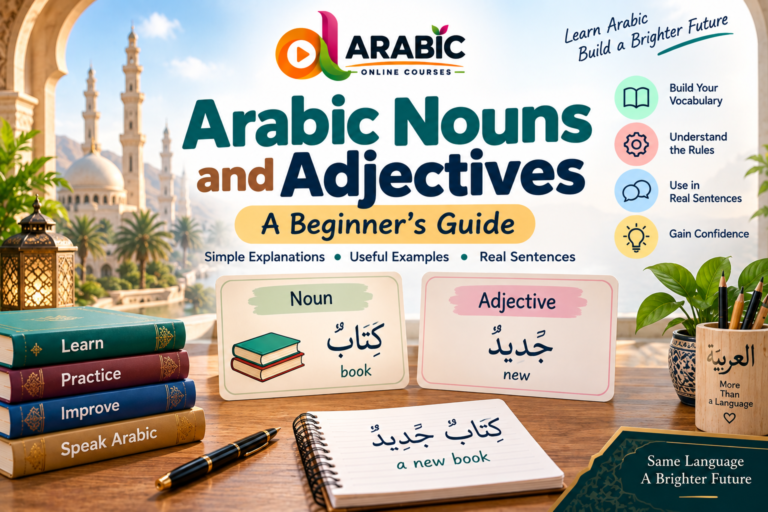
Understanding how nouns work is an essential part of Arabic grammar. You can also explore Arabic Nouns and Adjectives to learn more about noun gender, number, definiteness, and the relationship between nouns and adjectives.
A noun can be used as the subject or object of a sentence.
Example:
- الطالبُ مجتهدٌ. — The student is hardworking.
- قرأتُ الكتابَ. — I read the book.
- Verbs
A verb expresses an action or state.
Examples:
Arabic | English |
كتب | Wrote |
قرأ | Read |
ذهب | Went |
أكل | Ate |
شرب | Drank |
يدرس | Studies |
يكتب | Writes |
Example:
- يقرأ الطالبُ. — The student reads.
- ذهب محمدٌ إلى المدرسة. — Muhammad went to school.
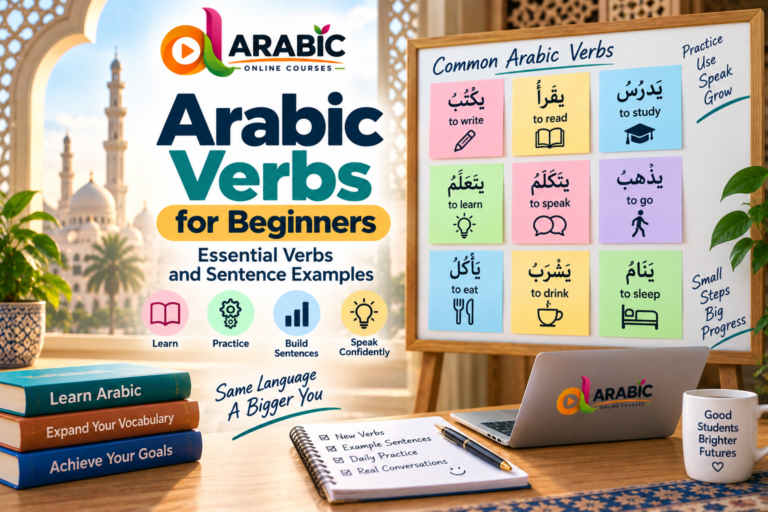
Verbs are one of the three main categories of Arabic words and are essential for describing actions and events. Our Arabic Verbs for Beginners guide provides more practice with common Arabic verbs, verb forms, conjugation, and everyday examples.
- Particles
Particles are small words that connect other words or give them additional meaning.
Examples:
Arabic | English |
في | In |
على | On |
من | From |
إلى | To |
مع | With |
و | And |
أو | Or |
هل | Is / Are / Do |
Example:
- الكتابُ على الطاولة. — The book is on the table.
- ذهبتُ إلى المدرسة. — I went to school.
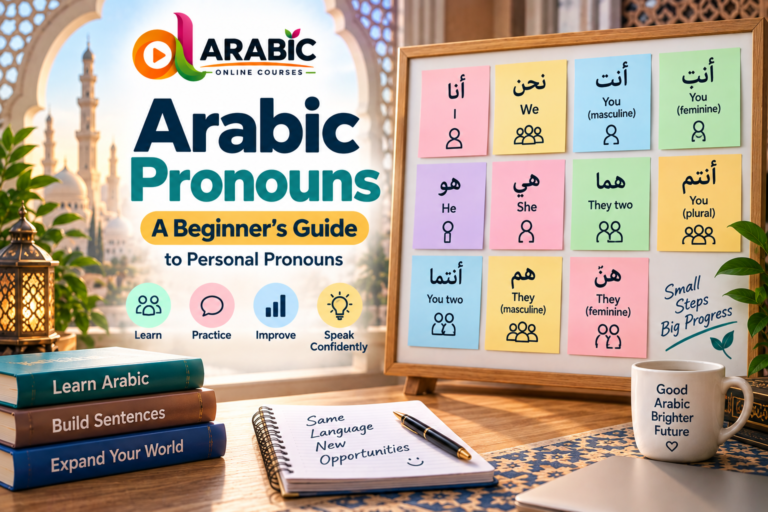
Arabic Personal Pronouns
Personal pronouns are words used instead of nouns. They are essential for forming basic Arabic sentences.
English | Arabic |
I | أنا |
We | نحن |
You — masculine | أنتَ |
You — feminine | أنتِ |
You two | أنتما |
You — plural masculine | أنتم |
You — plural feminine | أنتنّ |
He | هو |
She | هي |
They two | هما |
They — masculine | هم |
They — feminine | هنّ |
Examples with Arabic Pronouns
- أنا طالبٌ. — I am a student.
- أنا طالبةٌ. — I am a female student.
- هو معلّمٌ. — He is a teacher.
- هي معلّمةٌ. — She is a teacher.
- نحن أصدقاء. — We are friends.
- هم طلابٌ. — They are students.
Arabic pronouns are important because verbs and adjectives often change according to the person and gender.
For a more detailed explanation, you can later explore our guide to Arabic pronouns.
Masculine and Feminine in Arabic
Arabic nouns are generally classified as masculine or feminine. This distinction affects adjectives, verbs, and other words connected to the noun.
Masculine Nouns
Examples:
- ولد — Boy
- طالب — Male student
- كتاب — Book
- قلم — Pen
- باب — Door
Feminine Nouns
Examples:
- بنت — Girl
- طالبة — Female student
- سيارة — Car
- مدرسة — School
- شجرة — Tree
Many feminine nouns end with ة, called taa marbuta, although not every feminine noun follows this pattern.
Examples of Gender Agreement
- طالبٌ مجتهدٌ. — A hardworking male student.
- طالبةٌ مجتهدةٌ. — A hardworking female student.
- ولدٌ صغيرٌ. — A young boy.
- بنتٌ صغيرةٌ. — A young girl.
The adjective must agree with the noun in gender.
Singular, Dual, and Plural in Arabic
One special feature of Arabic grammar is that nouns can appear in three numbers:
- Singular — one person or thing.
- Dual — two people or things.
- Plural — three or more people or things.
Singular
- طالب — One male student
- طالبة — One female student
- كتاب — One book
Dual
- طالبان — Two male students
- طالبتان — Two female students
- كتابان — Two books
Plural
- طلاب — Male students
- طالبات — Female students
- كتب — Books
Arabic plurals can be regular or irregular. Irregular plurals are often called broken plurals because the internal structure of the word changes.
Examples:
- كتاب → كتب — Book → Books
- رجل → رجال — Man → Men
- مدينة → مدن — City → Cities
Beginners should first focus on common plural forms and learn irregular plurals through practice.
The Arabic dual is one of the features that makes Arabic different from many other languages. If you are also learning how Arabic numbers are used with nouns and in everyday situations, our Arabic Numbers for Beginners guide provides practical examples.
Definite and Indefinite Nouns
Arabic nouns can be definite or indefinite.
Indefinite Nouns
An indefinite noun refers to something general or unspecified.
Examples:
- كتابٌ — A book
- طالبٌ — A student
- بيتٌ — A house
Definite Nouns
A definite noun refers to something specific. One common way to make a noun definite is to add ال at the beginning.
Examples:
- الكتابُ — The book
- الطالبُ — The student
- البيتُ — The house
Compare:
- رأيتُ كتابًا. — I saw a book.
- رأيتُ الكتابَ. — I saw the book.
The prefix ال is an important feature of basic Arabic grammar.
Arabic Adjectives
Adjectives describe nouns. In Arabic, adjectives generally follow the nouns they describe.
An adjective usually agrees with the noun in:
- Gender.
- Number.
- Definiteness.
- Grammatical case in formal Arabic.
Examples of Arabic Adjectives
Arabic | English |
كبير | Big |
صغير | Small |
جميل | Beautiful |
جديد | New |
قديم | Old |
طويل | Tall / Long |
قصير | Short |
سريع | Fast |
بطيء | Slow |
مجتهد | Hardworking |
Examples of Adjective Agreement
- كتابٌ جديدٌ. — A new book.
- الكتابُ الجديدُ. — The new book.
- سيارةٌ جديدةٌ. — A new car.
- السيارةُ الجديدةُ. — The new car.
Notice how جديد changes to جديدة when describing a feminine noun.
Arabic Sentence Structure
Arabic sentences generally follow two main patterns:
- Nominal sentences.
- Verbal sentences.
Understanding these patterns is an essential part of Arabic grammar for beginners.
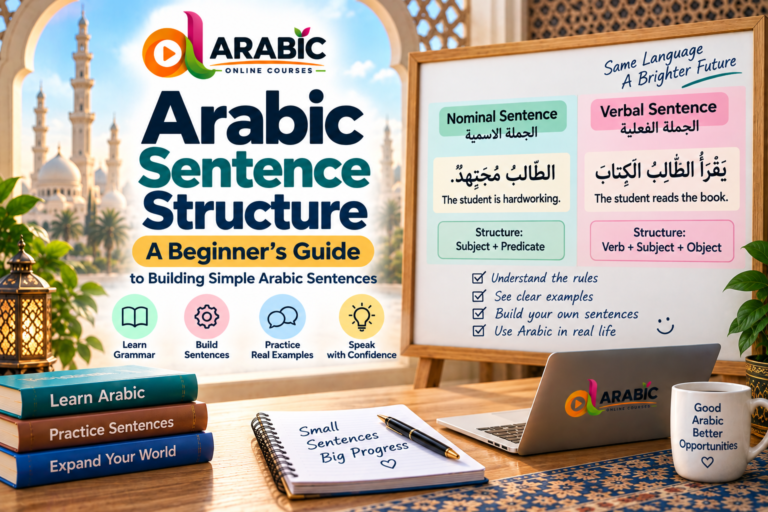
Nominal Sentences in Arabic
A nominal sentence, or الجملة الاسمية, usually begins with a noun or pronoun. It often consists of two main parts:
- The subject or topic.
- The information given about the subject.
The first part is called المبتدأ, and the second part is called الخبر.
Examples
- الجوُّ جميلٌ. — The weather is beautiful.
- البيتُ كبيرٌ. — The house is big.
- الطالبُ مجتهدٌ. — The student is hardworking.
- أنا سعيدٌ. — I am happy.
In the sentence البيتُ كبيرٌ:
- البيتُ is the subject or topic.
- كبيرٌ gives information about the house.
In the present tense, Arabic often does not require a separate verb meaning “is” or “are” in simple nominal sentences.
Learning the main types of Arabic sentences is an important step toward using grammar correctly. Our guide to Arabic Sentence Structure explains nominal and verbal sentences, word order, subjects, objects, and common sentence patterns.
Verbal Sentences in Arabic
A verbal sentence, or الجملة الفعلية, usually begins with a verb.
A basic verbal sentence may include:
- A verb.
- A subject.
- An object.
Examples
- قرأَ الطالبُ الكتابَ. — The student read the book.
- كتبَ الولدُ الرسالةَ. — The boy wrote the letter.
- شربَ الطفلُ الحليبَ. — The child drank the milk.
- ذهبَ أحمدُ إلى المدرسة. — Ahmad went to school.
In the sentence قرأَ الطالبُ الكتابَ:
- قرأَ is the verb.
- الطالبُ is the subject.
- الكتابَ is the object.
Arabic Verbs and Tenses
Arabic verbs can express different times. Beginners usually start with three main categories:
- Past tense.
- Present tense.
- Imperative.
Past Tense
The past tense describes an action that happened before now.
Examples:
- كتبَ — He wrote.
- قرأَ — He read.
- ذهبَ — He went.
- أكلَ — He ate.
Example sentence:
- قرأَ الطالبُ الدرسَ. — The student read the lesson.
Present Tense
The present tense describes an action happening now or regularly.
Examples:
- يكتبُ — He writes.
- يقرأُ — He reads.
- يذهبُ — He goes.
- يأكلُ — He eats.
Example sentence:
- يقرأُ الطالبُ الدرسَ. — The student is reading the lesson.
Imperative
The imperative is used to give a command or instruction.
Examples:
- اكتبْ. — Write.
- اقرأْ. — Read.
- اذهبْ. — Go.
- اسمعْ. — Listen.
The exact form of the imperative changes depending on the person being addressed.
For more practice, you can explore our future guide to Arabic verbs for beginners.
Arabic Prepositions
Prepositions are short words that show relationships between nouns and other words.
Common Arabic prepositions include:
Arabic | English |
في | In |
على | On |
تحت | Under |
أمام | In front of |
خلف | Behind |
بجانب | Beside |
من | From |
إلى | To |
عن | About |
مع | With |
بدون | Without |
Examples
- الكتابُ في الحقيبة. — The book is in the bag.
- القلمُ على المكتب. — The pen is on the desk.
- السيارةُ أمام البيت. — The car is in front of the house.
- ذهبتُ مع صديقي. — I went with my friend.
Learning prepositions helps beginners create longer and more meaningful sentences.
Arabic Question Words
Question words allow learners to ask for information and participate in conversations.
English | Arabic |
What? | ما / ماذا |
Who? | من |
Where? | أين |
When? | متى |
Why? | لماذا |
How? | كيف |
How much? | كم |
Which? | أيّ |
Is / Are / Do? | هل |
Examples
- ما اسمك؟ — What is your name?
- من هذا؟ — Who is this?
- أين الكتاب؟ — Where is the book?
- متى الدرس؟ — When is the lesson?
- كيف حالك؟ — How are you?
- هل تتحدث العربية؟ — Do you speak Arabic?
Question words are useful for practicing grammar through real conversations.
Basic Arabic Grammar Practice Sentences
The following sentences combine several beginner grammar concepts:
Arabic Sentence | English Meaning |
أنا طالبٌ. | I am a student. |
هي معلّمةٌ. | She is a teacher. |
هذا كتابٌ جديدٌ. | This is a new book. |
البيتُ كبيرٌ. | The house is big. |
يقرأُ الولدُ الكتابَ. | The boy reads the book. |
ذهبتُ إلى المدرسة. | I went to school. |
القلمُ على الطاولة. | The pen is on the table. |
هؤلاء طلابٌ مجتهدون. | These are hardworking students. |
عندي كتابان. | I have two books. |
أحبُّ اللغةَ العربيةَ. | I love the Arabic language. |
Read these sentences aloud and try to identify the nouns, verbs, adjectives, pronouns, and prepositions.
Prepositions are small but important words that show relationships between people, places, objects, and actions. To practice these structures in more detail, see our guide to Arabic Prepositions for Beginners.
How to Learn Arabic Grammar Effectively
Learning Arabic grammar for beginners becomes easier when you follow a clear and gradual method.
1. Start with Simple Rules
Begin with basic concepts such as nouns, pronouns, verbs, gender, and sentence structure. Avoid studying advanced grammatical details too early.
2. Learn Grammar Through Examples
Rules become easier to understand when you see them in complete sentences. Study the sentence first, then identify the grammar pattern.
3. Practice One Topic at a Time
Focus on one topic during each study session. For example:
- Day one: Personal pronouns.
- Day two: Masculine and feminine nouns.
- Day three: Nominal sentences.
- Day four: Past-tense verbs.
- Day five: Prepositions.
4. Write Your Own Sentences
After learning a grammar rule, write three to five sentences using it. This helps you move from understanding the rule to applying it.
5. Read Simple Arabic Texts
Reading short, vowelled texts can help you recognize grammar patterns in context. Start with simple dialogues, stories, and educational passages.
6. Practice with a Teacher
A qualified Arabic teacher can explain difficult rules, correct mistakes, and help you use grammar naturally in conversation. [Online Arabic lessons] can provide structured practice based on your level and goals.
Common Arabic Grammar Mistakes
Confusing Masculine and Feminine Forms
Learners may use a masculine adjective with a feminine noun or vice versa. Always check whether the noun is masculine or feminine.
Forgetting Adjective Agreement
Arabic adjectives generally follow the nouns they describe and agree with them in gender and number.
Using the Wrong Pronoun
Arabic has different pronouns for masculine, feminine, dual, and plural forms. Practice them regularly.
Translating English Word for Word
Arabic sentence structure may differ from English. Try to learn complete Arabic patterns instead of translating every word directly.
Studying Rules Without Practice
Understanding a rule is not enough. You need to use it in speaking and writing to remember it effectively.
A Simple Daily Arabic Grammar Study Plan
You can practice Arabic grammar for 20 to 30 minutes each day.
Time | Activity |
5 minutes | Review a previous grammar rule |
5 minutes | Learn one new concept |
5 minutes | Read example sentences |
5 minutes | Write your own sentences |
5–10 minutes | Practice speaking or complete exercises |
Consistency is more important than studying for long hours only once a week.
Once you understand the basic grammar concepts covered in this guide, you can continue developing your skills through more systematic study. Our Arabic Grammar Course goes deeper into sentence structure, nouns, pronouns, adjectives, verbs, prepositions, case endings, and other important areas of Arabic grammar.
Frequently Asked Questions
Is Arabic grammar difficult for beginners?
Arabic grammar can seem difficult because it includes features such as gender, dual forms, and different verb patterns. However, learning one topic at a time makes the process more manageable.
What should I learn first in Arabic grammar?
Start with nouns, pronouns, masculine and feminine forms, basic verbs, prepositions, and simple sentence structure.
Does Arabic have grammar rules similar to English?
Some concepts are similar, such as nouns, verbs, adjectives, and pronouns. However, Arabic has its own systems for gender, word agreement, verb patterns, and sentence structure.
Do I need to learn grammar before speaking Arabic?
You can begin speaking with simple phrases while learning grammar. Grammar helps you improve accuracy, but you do not need to master all grammar rules before starting conversations.
What is the difference between a nominal and verbal sentence?
A nominal sentence generally begins with a noun or pronoun, while a verbal sentence generally begins with a verb.
How can I practice Arabic grammar at home?
Read simple Arabic sentences, identify grammar patterns, write your own examples, review regularly, and practice speaking with a teacher or language partner.
Conclusion
Learning Arabic grammar for beginners is an important stage in developing strong Arabic communication skills. By understanding nouns, pronouns, verbs, adjectives, gender, numbers, prepositions, and sentence structure, you can begin forming more accurate Arabic sentences.
The key is to study gradually and practice consistently. Do not worry about mastering every rule immediately. Start with simple examples, use new grammar in conversations, and continue building your knowledge step by step.
With regular practice and proper guidance, Arabic grammar can become easier to understand and apply.
Start learning Arabic grammar today and build a stronger foundation for reading, writing, and speaking Arabic.