Skip to the content


Arabic Alphabet for Beginners: Letter Forms and Positions
Learning the Arabic alphabet for beginners is the first important step toward reading, writing, and speaking Arabic. The Arabic writing system may look unfamiliar at first, especially for learners who are used to the Latin alphabet. However, with regular practice and a clear explanation of each letter, learning the Arabic alphabet becomes much easier.
Arabic is written from right to left and contains 28 basic letters. Many letters change their shape depending on whether they appear at the beginning, middle, or end of a word. Understanding these forms will help you recognize Arabic words and begin reading simple texts.
If you are starting your Arabic learning journey, this guide will introduce you to the Arabic letters, their names, sounds, forms, and practical ways to practice them.
For a broader introduction to Arabic learning, you can also read our complete guide to learning Arabic online.
This guide to the Arabic alphabet for beginners will help you recognize the letters, understand their sounds, and practice reading and writing Arabic words.
In this guide
- Understanding the Arabic Alphabet
- The 28 Arabic Letters for Beginners
- Arabic Alphabet Letter Forms and Positions
- Why Do Arabic Letters Change Shape?
- Arabic Letters That Do Not Connect to the Following Letter
- Arabic Short Vowels and Diacritical Marks
- How to Pronounce Difficult Arabic Letters
- Arabic Alphabet Examples
- A Simple Method to Learn the Arabic Alphabet
- Practice Reading Simple Arabic Words
- Practice Writing Arabic Letters
- Arabic Letters with Similar Shapes
- Common Mistakes Arabic Beginners Should Avoid
- How Long Does It Take to Learn the Arabic Alphabet?
- Continue Your Arabic Learning Journey
- Frequently Asked Questions
- Conclusion
Understanding the Arabic Alphabet
The Arabic alphabet consists of 28 basic letters. Unlike English, Arabic is written from right to left.
For example:
- English: Hello
- Arabic: مرحبًا
Arabic letters are connected in most words. Some letters connect to the letter before them but do not connect to the letter after them. This is one of the main differences beginners need to understand.
The Arabic alphabet is used in Modern Standard Arabic and many Arabic dialects. Although pronunciation may vary slightly between regions, the basic letters remain the same.
The 28 Arabic Letters for Beginners
The following table presents the 28 Arabic letters in their basic forms, along with their names and approximate sounds.
Letter | Name | Approximate Sound |
ا | Alif | A or long aa |
ب | Baa | B |
ت | Taa | T |
ث | Thaa | Th as in “think” |
ج | Jeem | J |
ح | Haa | Strong breathy H |
خ | Khaa | Kh |
د | Daal | D |
ذ | Dhaal | Th as in “this” |
ر | Raa | Rolled or tapped R |
ز | Zaay | Z |
س | Seen | S |
ش | Sheen | Sh |
ص | Saad | Emphatic S |
ض | Daad | Emphatic D |
ط | Taa | Emphatic T |
ظ | Zaa | Emphatic Dh or Z |
ع | Ayn | A special throat sound |
غ | Ghayn | Gh |
ف | Faa | F |
ق | Qaaf | Deep Q |
ك | Kaaf | K |
ل | Laam | L |
م | Meem | M |
ن | Noon | N |
ه | Haa | H |
و | Waaw | W or long uu |
ي | Yaa | Y or long ii |
The approximate English sounds are only a starting point. Some Arabic sounds, such as ع, ح, خ, غ, and ق, require special practice because they do not have exact equivalents in English.
Learning the Arabic alphabet for beginners is easier when students study the letters in small groups and practice each sound regularly.
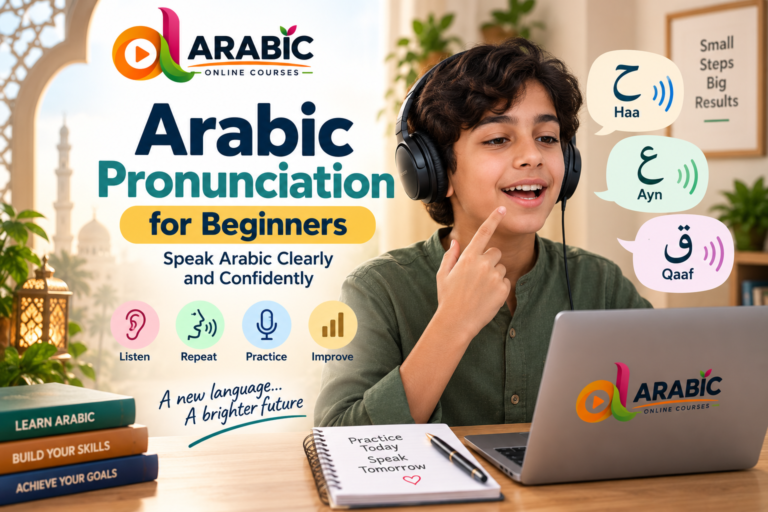
Some Arabic sounds may be difficult for beginners because they do not have exact equivalents in English. To practice these sounds and improve your pronunciation step by step, explore our guide to Arabic Pronunciation for Beginners.
Arabic Alphabet Letter Forms and Positions
One of the most important things to understand when learning the Arabic alphabet is that many letters have different shapes depending on their position in a word.
A letter may appear in four possible forms:
- Isolated form
- Initial form
- Medial form
- Final form
For example, the letter ب may appear as follows:
Position | Form |
Isolated | ب |
Initial | بـ |
Medial | ـبـ |
Final | ـب |
Although the shape changes, the letter remains the same and keeps the same basic sound.
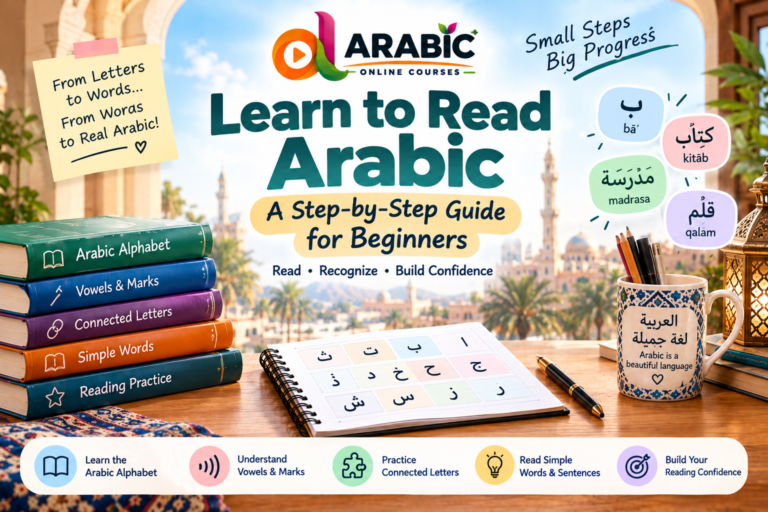
Once you understand the basic Arabic letters and how their shapes change within words, you can begin practicing complete words and short texts. Our guide to Learn to Read Arabic takes you from individual letters to connected words and simple Arabic sentences.
Why Do Arabic Letters Change Shape?
Arabic letters are often connected to create words. The changes in shape make the writing flow naturally from right to left.
For example:
- بَاب — Door
- كِتَاب — Book
- بَيْت — House
The letters may look different when connected, but learners can recognize them with practice.
Arabic Letters That Do Not Connect to the Following Letter
Six Arabic letters do not connect to the letter that comes after them. These letters are:
ا، د، ذ، ر، ز، و
They may connect to a preceding letter, but they do not connect forward to the next letter.
For example:
- دار — House
- روز — Rose
- نور — Light
Learning these six letters early can help beginners understand why some Arabic words appear to have breaks between letters.
Writing the Arabic letters repeatedly can help you remember their shapes and understand how they connect in different positions. For more structured practice with Arabic handwriting, connected letters, and writing simple words and sentences, see Arabic Writing for Beginners.
Arabic Short Vowels and Diacritical Marks
Arabic writing often omits short vowels in ordinary texts. Beginners usually learn these vowels through diacritical marks, which are called harakat.
The three main short vowels are:
Mark | Name | Sound | Example |
َ | Fatḥah | Short “a” | بَ |
ِ | Kasrah | Short “i” | بِ |
ُ | Ḍammah | Short “u” | بُ |
There are also other important marks:
Mark | Name | Function |
ْ | Sukūn | Indicates no vowel |
ّ | Shaddah | Doubles the consonant |
ً | Fatḥatayn | “an” ending |
ٍ | Kasratayn | “in” ending |
ٌ | Ḍammatayn | “un” ending |
For example, the letter ب can be pronounced differently depending on the vowel:
- بَ — ba
- بِ — bi
- بُ — bu
Learning these marks will help you read Arabic words more accurately.
How to Pronounce Difficult Arabic Letters
Some Arabic letters require more practice than others. Beginners should listen carefully to native speakers and repeat the sounds regularly.
The Letter ح
The letter ح is pronounced as a strong, breathy sound from the middle of the throat. It is different from the lighter English “h.”
Example:
- حُبّ — Love
The Letter خ
The letter خ produces a sound made in the upper throat. It is often represented as “kh” in English transliteration.
Example:
- خُبز — Bread
The Letter ع
The letter ع is one of the most distinctive Arabic sounds. It is produced from the throat and may be difficult for beginners at first.
Example:
- عَيْن — Eye
The Letter غ
The letter غ is a deep sound that may resemble the French “r” in some pronunciations.
Example:
- غُرفة — Room
The Letter ق
The letter ق is pronounced deep in the mouth and is different from the English “k.”
Example:
- قَلَم — Pen
Do not expect to master these sounds immediately. Listen, repeat, and practice them slowly.
Arabic Alphabet Examples
Learning letters becomes easier when you see them used in familiar words.
Arabic Word | Meaning | Important Letter |
أَب | Father | ا |
بَيْت | House | ب |
تَمْر | Dates | ت |
جَمَل | Camel | ج |
حُبّ | Love | ح |
خُبز | Bread | خ |
دَرس | Lesson | د |
ذَهَب | Gold | ذ |
رَجُل | Man | ر |
زَهْرة | Flower | ز |
سَمَك | Fish | س |
شَمْس | Sun | ش |
صَباح | Morning | ص |
طَالِب | Student | ط |
عَيْن | Eye | ع |
غُرفة | Room | غ |
قَلَم | Pen | ق |
كِتَاب | Book | ك |
لَيْل | Night | ل |
مَدْرَسة | School | م |
نَهْر | River | ن |
وَرَق | Paper | و |
يَد | Hand | ي |
Try reading each word from right to left. Start slowly, identify each letter, and then combine the sounds.
Learning individual letters becomes more meaningful when you see them used in familiar words. Our Arabic Vocabulary for Beginners guide introduces practical Arabic words and expressions that can help you expand your vocabulary while continuing to practice reading.
A Simple Method to Learn the Arabic Alphabet
Learning all 28 letters in one session may be overwhelming. Instead, divide the alphabet into small groups.
Step 1: Learn Five Letters at a Time
Begin with a small group of letters. For example:
ا، ب، ت، ث، ج
Practice their names, sounds, and written forms before moving to the next group.
Step 2: Write Each Letter Repeatedly
Write each letter in its isolated form first. Then practice its connected forms.
For each letter, write:
- Isolated form
- Initial form
- Medial form
- Final form
Step 3: Say the Sounds Aloud
Do not only look at the letters. Say each sound aloud as you write it.
This helps connect visual recognition with pronunciation.
Saying Arabic sounds aloud is important, but listening carefully is equally important because it helps you recognize how native speakers produce different sounds. Regular Arabic Listening Practice can help you connect what you see in writing with what you hear in spoken Arabic.
Step 4: Learn a Word for Each Letter
Associate each letter with a familiar Arabic word. For example:
- ب — بيت
- ت — تمر
- ج — جمل
- س — سمك
This makes the learning process more memorable.
Step 5: Review Frequently
Review previously learned letters every day. Repetition is essential for remembering the shapes and sounds.
Practice Reading Simple Arabic Words
Once you know several letters, begin reading short words. Start with words that contain familiar letters and clear vowel marks.
Examples include:
- بَاب — Door
- بَيْت — House
- كِتَاب — Book
- قَلَم — Pen
- مَاء — Water
- شَمْس — Sun
- نُور — Light
When reading a word, follow these steps:
- Identify each letter.
- Recognize the vowel marks.
- Connect the sounds.
- Read the complete word.
- Repeat the word aloud.
Do not worry if reading feels slow at first. Speed will improve with regular practice.
As you move from individual letters to complete words, you will begin encountering Arabic nouns and descriptive words in simple sentences. Our guide to Arabic Nouns and Adjectives explains how nouns and adjectives work together, including gender, number, and agreement.
Practice Writing Arabic Letters
Writing Arabic by hand can help you remember letter shapes and understand how letters connect.
Use a notebook and practice each letter several times. Pay attention to:
- The direction of writing.
- The number and position of dots.
- The shape of connected letters.
- The difference between similar letters.
Arabic Letters with Similar Shapes
Some Arabic letters share similar shapes but differ in the number or position of dots.
For example:
Letters | Difference |
ب، ت، ث | One, two, or three dots |
ج، ح، خ | Dot below, no dot, or dot above |
د، ذ | One letter has a dot |
ر، ز | One letter has a dot |
س، ش | Sheen has three dots |
ص، ض | Daad has a dot |
ط، ظ | Zaa has a dot |
Learning these groups together can help you recognize the differences more quickly.
Understanding these forms is an essential part of mastering the Arabic alphabet for beginners, especially when moving from individual letters to complete words.
Common Mistakes Arabic Beginners Should Avoid
Confusing Similar Letters
Beginners may confuse letters such as ب، ت، ث or ج، ح، خ. Focus on the dots and repeat the differences regularly.
Forgetting the Writing Direction
Arabic is written from right to left. Practice following the correct direction from the beginning.
Ignoring Short Vowels
Short vowels can change pronunciation and meaning. Practice reading words with vowel marks before moving to unmarked texts.
Learning Letter Names Without Their Sounds
Knowing that a letter is called Meem is not enough. You should also know that it represents the m sound.
Trying to Memorize Everything at Once
Learning gradually is more effective than studying all 28 letters in one sitting. Divide the alphabet into small groups and review often.
How Long Does It Take to Learn the Arabic Alphabet?
Many beginners can recognize the basic Arabic letters within a few days or weeks, depending on their study routine. However, learning to read connected words fluently may take longer.
Your progress depends on:
- How often you practice.
- Whether you write the letters by hand.
- How much listening you do.
- Whether you review regularly.
- Whether you receive feedback from a teacher.
A practical routine is to study for 15 to 20 minutes each day. Consistent practice is usually more effective than one long study session each week.
Continue Your Arabic Learning Journey
Learning the alphabet is only the beginning. After you become familiar with the letters, you can move on to vocabulary, pronunciation, grammar, reading, writing, and conversation.
Our article, learn Arabic from scratch step by step, explains how beginners can continue learning Arabic after mastering the basics.
If you prefer structured instruction, online Arabic lessons can help you practice pronunciation, reading, writing, and conversation with a qualified teacher.
Frequently Asked Questions
How many letters are in the Arabic alphabet?
The Arabic alphabet contains 28 basic letters.
Is the Arabic alphabet difficult to learn?
The Arabic alphabet may seem unfamiliar at first, but it becomes easier with regular practice. Learning a few letters at a time can make the process more manageable.
Is Arabic written from right to left?
Yes. Arabic is generally written and read from right to left.
Do Arabic letters change their shape?
Yes. Many Arabic letters change their shape depending on whether they appear at the beginning, middle, or end of a word.
Which Arabic letters are the most difficult to pronounce?
Letters such as ع، ح، خ، غ، ق may be challenging for beginners because some of their sounds do not have exact equivalents in English.
Should I learn Arabic letters or vocabulary first?
It is best to begin with the Arabic alphabet and basic pronunciation. Once you understand the letters, learning vocabulary and reading words becomes easier.
Conclusion
Learning the Arabic alphabet for beginners is an essential first step toward understanding and using the Arabic language. By learning the 28 letters, practicing their sounds, recognizing their different forms, and reading simple words, you can build a strong foundation for your Arabic studies.
Take your time, practice consistently, and review what you learn. With patience and regular effort, the Arabic alphabet will become familiar, and you will be ready to move on to more advanced language skills.
Start learning the Arabic alphabet today and take your first step toward reading and understanding Arabic with confidence.